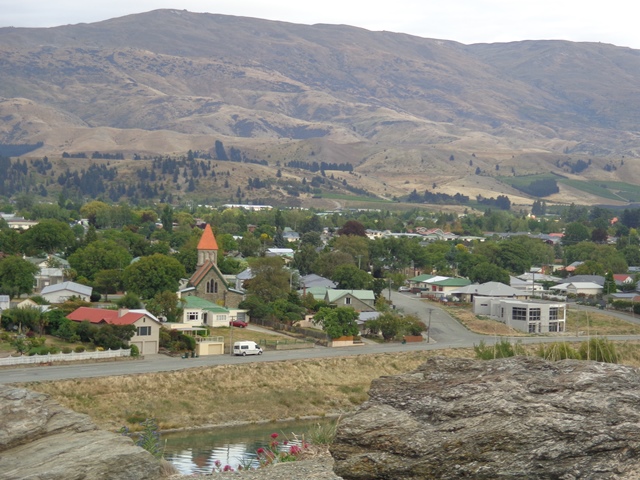
Way Down South
The past few months have been fairly hectic and it’s been a while since we took a trip so my wife and I decided to spend a few days at the bottom of the South Island. We hadn’t been down that way since 2003 and were hoping to find it as uncrowded and unspoiled as we remembered. And it was! Not only did we see some interesting things, we also met a lot of very interesting people.
We were at the very bottom of the South Island and the only thing further south is Antarctica.
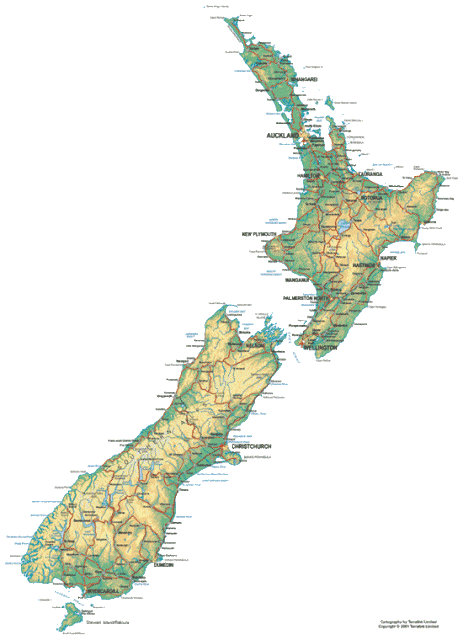
Here is our route:

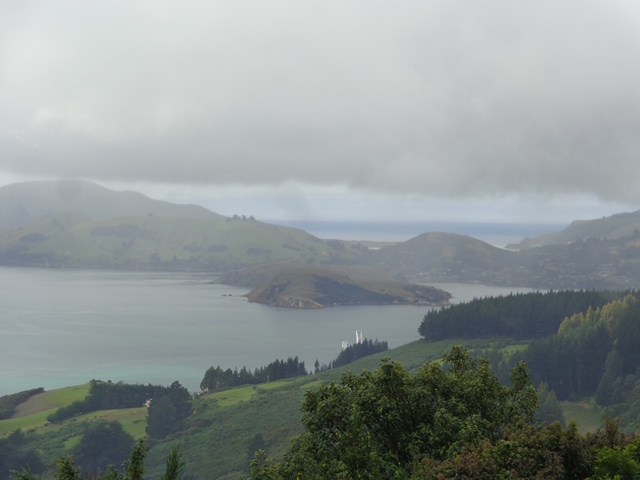
We flew into Dunedin, about 2 hours from Auckland, and picked up a rental car. Our first stop was the Orokonui Ecosanctuary just outside of Dunedin. It was a little cloudy but the views were great on the drive up.
Orokonui is dedicated to saving seriously endangered native wildlife. Before humans came to New Zealand, there were no mammals except for a small bat. As a result, birds didn’t have to worry about predators and over time they lost the ability to fly. Many NZ native birds are flightless and even if they can fly, they often spend a lot of their time on the ground and build their nests on the ground.
When humans arrived with rats, cats, dogs, weasels and stoats, a lot of native birds’ days were numbered and today many of them are either extinct or seriously endangered. In addition to predators, other introduced pests such as rabbits and possums destroy the habitat of many birds by eating vegetation.
The Department of Conservation has established several island bird sanctuaries, however over the past decade thanks to the initiative of several community groups around the country, a few mainland bird sanctuaries have been established too.
The Orokonui Sanctuary is 307 hecatares (about 750 acres) in size and in order to protect native wildlife in the sanctuary, a nine kilometre (about five and a half mile) predator proof fence has been built completely around the park. You start off in the very interesting visitor’s centre.
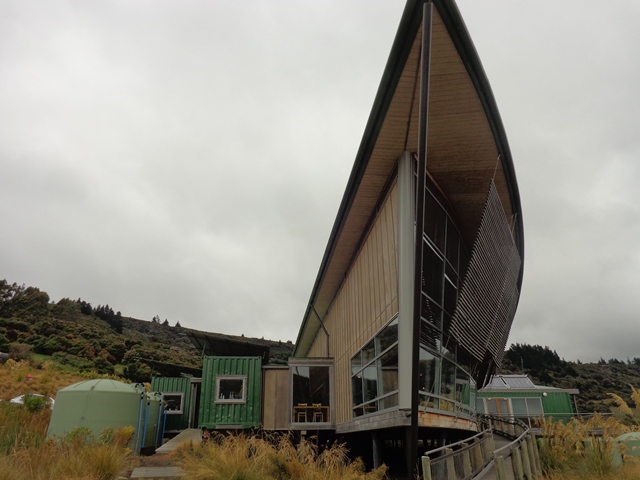
Once you register, you are given an access code for the gate to the fence. It’s a little bit like entering a maximum security prison. The fence is 2 metres high and mesh covered to prevent even baby mice from sneaking in. It has a metal skirt at the bottom to prevent animals from burrowing underneath and vegetation is cleared in a 4 metre wide path along the fence so that animals can’t climb neighbouring trees and jump over. There is also a sensor wire to set off an alarm if any animal tries to climb over the top. As I say, maximum security.
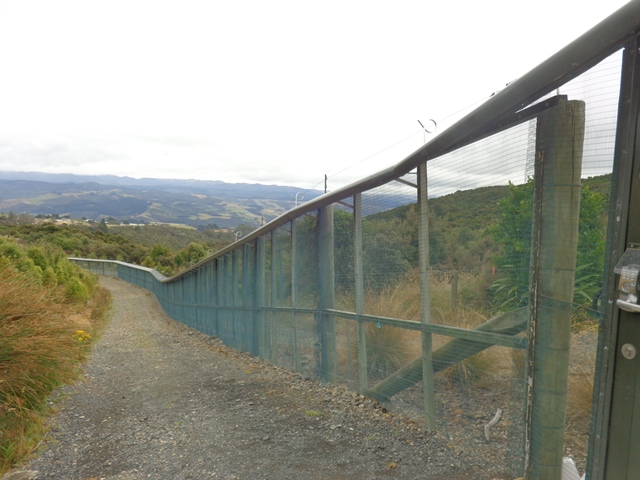
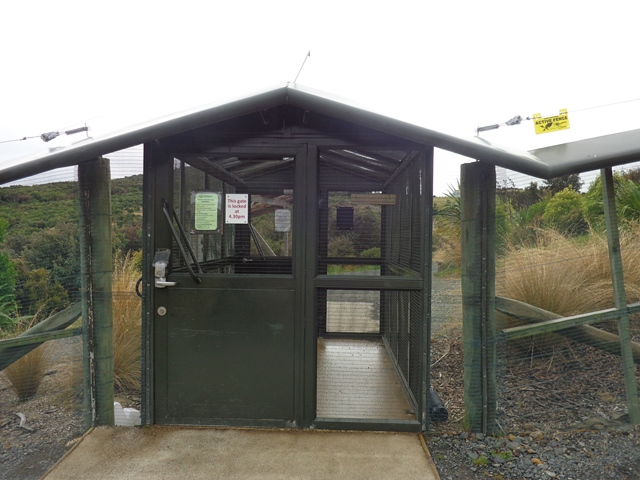
There are huge debates as to whether fences like this are economically justifiable. But it seems worthwhile when you get inside and see some of the birds that are wandering around. This is a takahe—a large adult can weigh ten pounds.

After spending a leisurely few hours at Orokonui we headed to Cromwell in Central Otago to visit our friends Heather and Paul. They used to live in Auckland but moved last year. As you drive north you leave the temperate rain forest and move into prairies and desert.


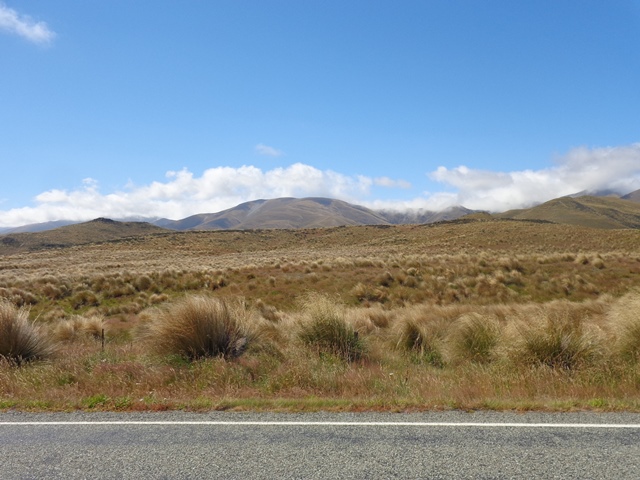
Cromwell has a population of about 4,000 and has the distinction of being the town in New Zealand that is farthest from the ocean—119 kilometres (about 70 miles). It is a lovely and interesting place.

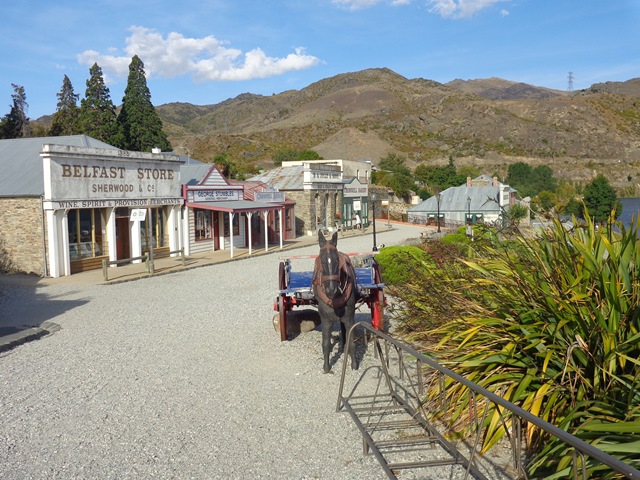
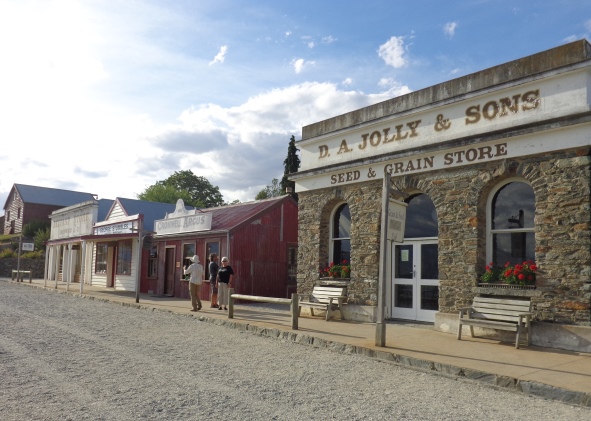
It was a boom town in the 1800s when gold was mined extensively in the area. And when you walk around you can see some of the old settlements. There are also warning signs to watch out for abandoned mine shafts.


Of course, this being New Zealand, the only thing that hadn’t abandoned the area were sheep!

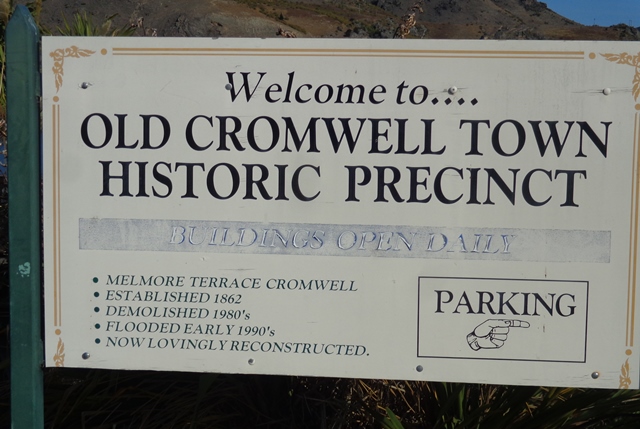
The Clutha River flows through Cromwell and in the 1990s a dam was built just south of the town to providehydroelectric power.
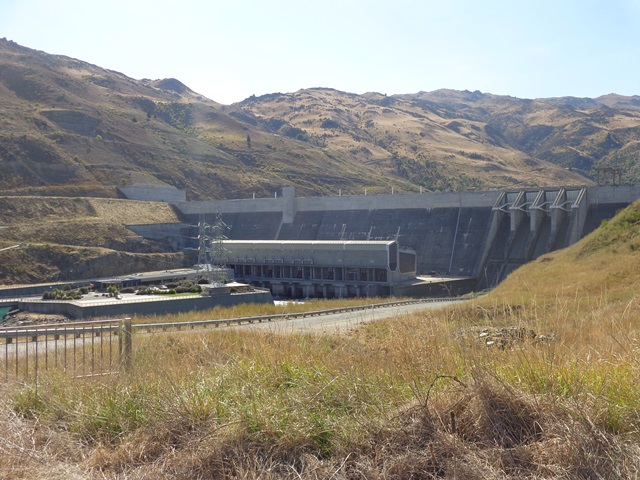
As a result, a good part of the old town is now underneath Lake Dunstan, which was formed by the dam. Over the past few years the old town has been reconstructed along the lake.
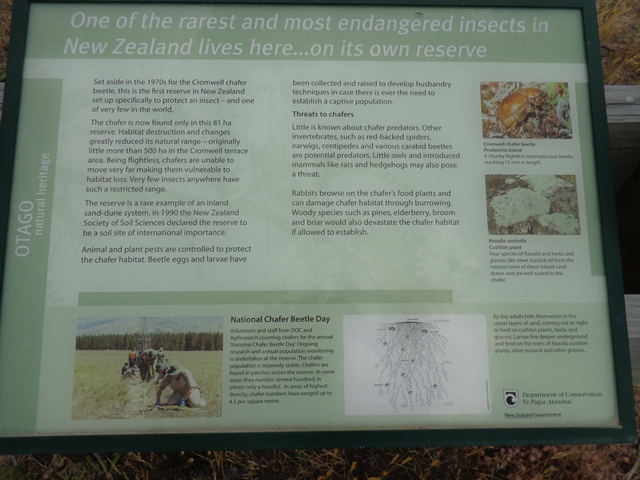
Before leaving Cromwell we visited New Zealand’s only bug reserve. The Chafer beetle lives only in New Zealand and is considered critically endangered. Like native birds, the beetles don’t fly and therefore are sitting ducks for introduced predators. In 1983 a 200 acre field was set aside to protect the beetles and at the time was the only reserve in the world created for an invertebrate.
To be honest, you don’t see a lot when you visit the reserve because the beetles live underground. And you can imagine that there are a lot of property developers wondering why some really prime real estate has been fenced off just for some bugs you can’t even see. I figure we can afford to give up 200 acres for bugs rather than a BMX track.

When people think of New Zealand, they usually think of two islands—North and South. However there is a third island and years ago, it was called the South Island and what is now the South Island was called the Middle Island. Today the original South Island is called Stewart Island or Rakiura. Stewart Island is much smaller than the other islands and has only about 400 inhabitants, most of whom are involved with either fishing or tourism.
Because of its isolation, there has never been significant human settlement or development on the island and many native New Zealand plants and animals which are threatened are able to survive. Tourism on the island focuses on nature walks and hikes and there are a number of walking tracks both on Stewart Island and its surrounding smaller islands.
You can reach the island by either a boat or plane from Invercargill which is the southernmost city in NZ. We had heard that the boat ride could be hair-raising because of rough seas and in fact was often cancelled. So we decided to take the plane. It did occur to me that flying through conditions that could prevent ships from getting through might make the flight a bit of an adventure.
And that concern was heightened when I saw the plane.
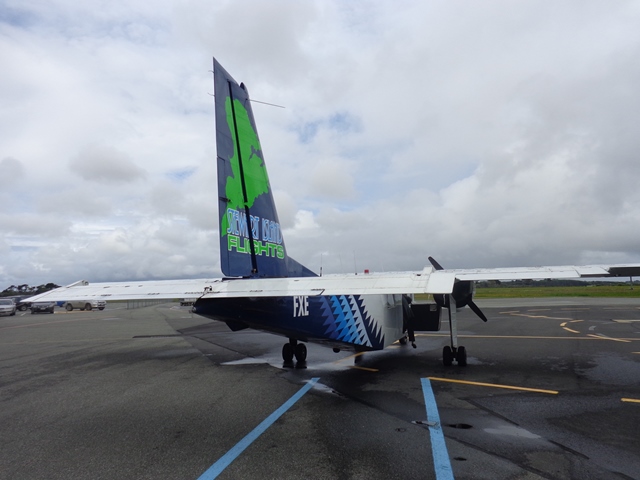
This is how it looked from the inside:
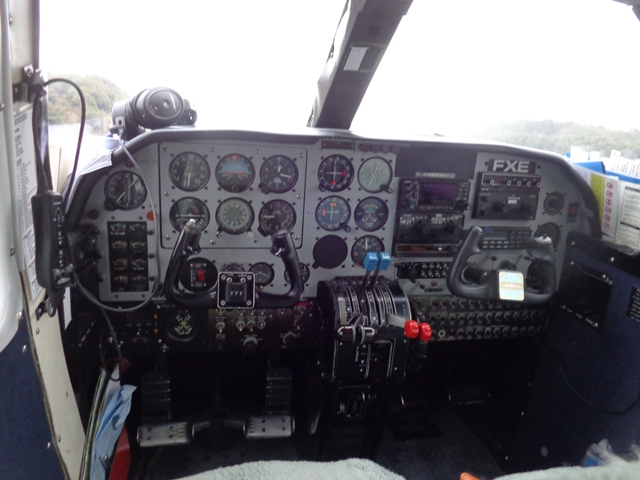
And here is a picture from the last row where we were sitting. There were an odd number of passengers so the extra person got to sit in the co-pilot’s seat. The pilot is telling him to keep his hands to himself and not touch anything. And I think the guy behind him is covering his eyes!

Actually the flight was very smooth and the only thing breathtaking was the scenery.
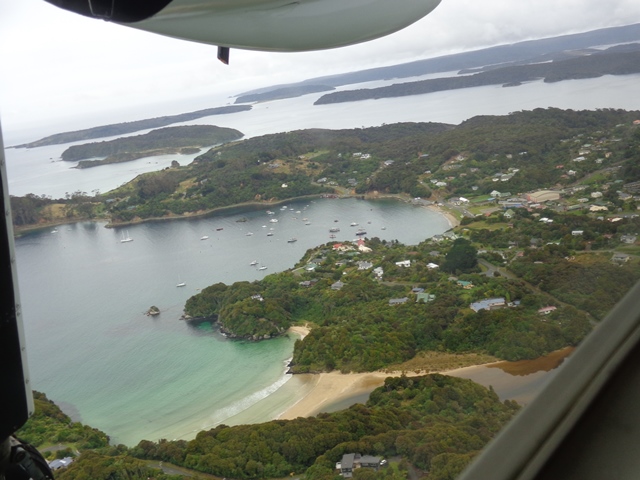
There was no airport, just an airstrip and a van from the town was waiting for us. Incidentally, the van is also the control tower. The pilot and van driver communicated on the radio about landing conditions.
The van dropped us at the depot in Oban, the only town on Stewart Island and home to over 80% of the people who live on the island.We were met by Andy, who with Jo, his wife runs Jo and Andy’s B&B which is where we would be staying. Andy, Jo and the B&B were all very interesting and we spent many hours in interesting conversations.
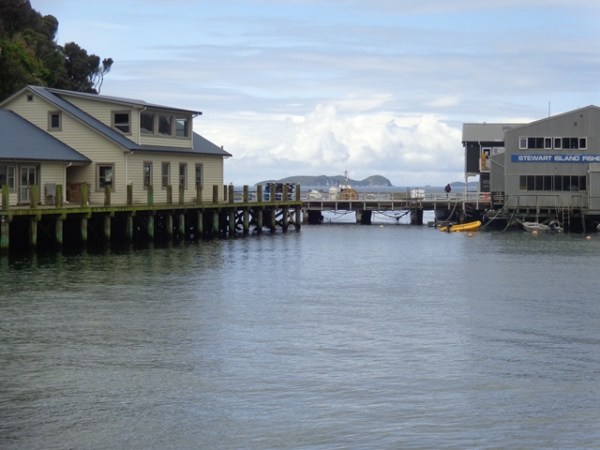
We spent a lot of time exploring Stewart Island, but the high point of our visit was a day trip to Ulva Island which is a ten minute boat ride from Oban.

The forest at Ulva Island was never logged for timber so unlike many other sanctuaries where the forest is only about 100– 200 years old, the trees here were several hundred years old. It was amazing and energizing walk.
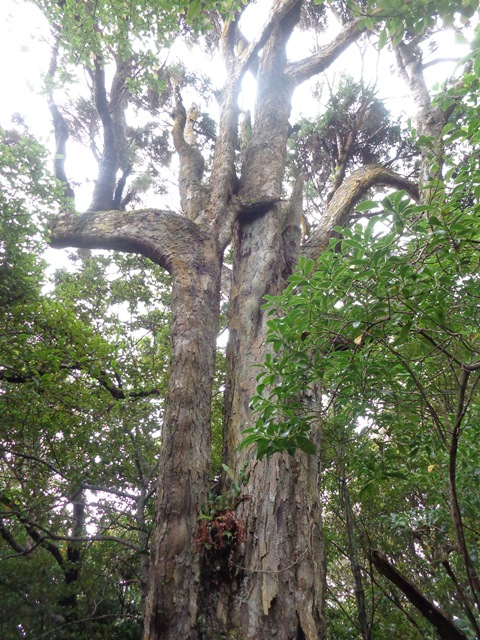
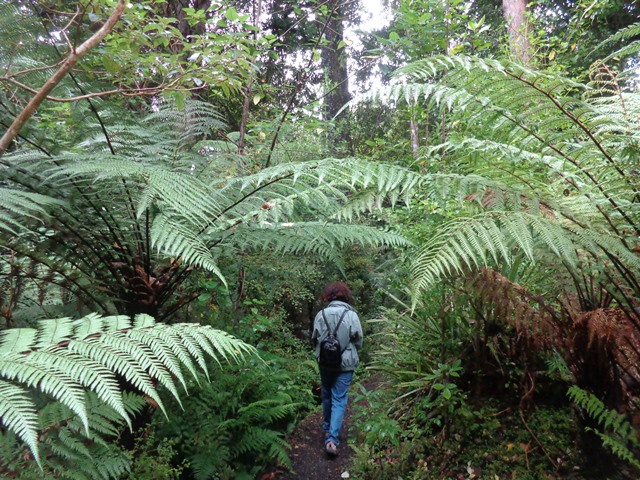
The Department of Conservation has laid out a series of beautifully constructed and well maintained walking tracks and you can explore the island on your own or get a guide.
Ulva Island is pest free and home to a huge variety of native NZ birds and we saw a lot of them.
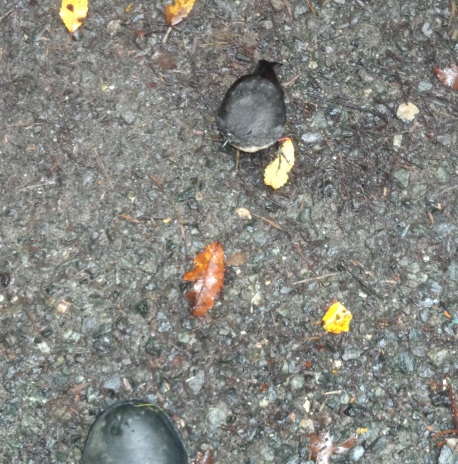
Because no one bothers the birds, other than tourists taking pictures, they are very friendly. The South Island robin, which doesn’t have a red breast, is very plentiful. In the hope that you will kick up some juicy bugs as you walk along, they follow you as you walk.
We also saw the NZ kaka, which is another indigenous and endangered parrot. They are big and noisy.

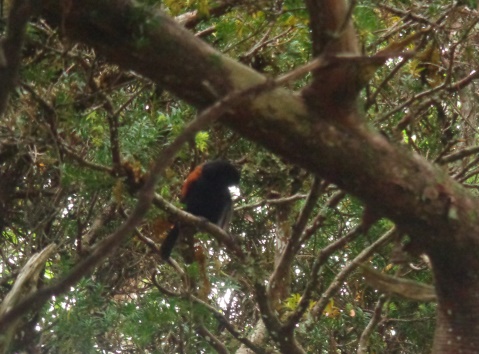
Another bird that is threatened outside of conservation parks is the saddleback. It is black with a brown patch on its back and red cheeks and has a lovely bird call.
And we were surprised when a kiwi ran across our path, but he was too quick to get a photo. Unlike the North Island kiwi, the South Island kiwi is not nocturnal. In the North Island there used to be a giant raptor (now extinct) that would feast on ground birds, so the kiwi up north evolved over time to be nocturnal. With no such predator in the South, the kiwi here are diurnal.
After three nice days on Stewart Island we took the early morning flight back to Invercargill. The plan for the rest of the trip was to do a leisurely drive along the southern coast back to Dunedin with a stop in Pounawea in the Catlins.
The Catlins Coast is the area of NZ between Invercargill and Balclutha. The population of the entire area is only about 1,200. The last time we were there, we were told to take in any food we wanted to the camp ground because there was only one grocery store and one restaurant—a fish and chips shop. After ten years, it hasn’t changed much although there are now more accommodation options, a bigger grocery store and five restaurants. But by and large it is a wonderfully wild and deserted area with lots of temperate rain forests and interesting birds and animals including seals and penguins.
Although the weather was fine while we were there, storms from the Southern Ocean can create havoc and there are two lighthouses along the way. The area has also been the site of many shipwrecks, including NZs worst maritime disaster.
Our first stop was Waipapa Point where in 1881 the SS Tararua sank in a storm with the loss of 131 lives. As a result, a lighthouse was built at the point in 1884. It is built of wood and still operates.
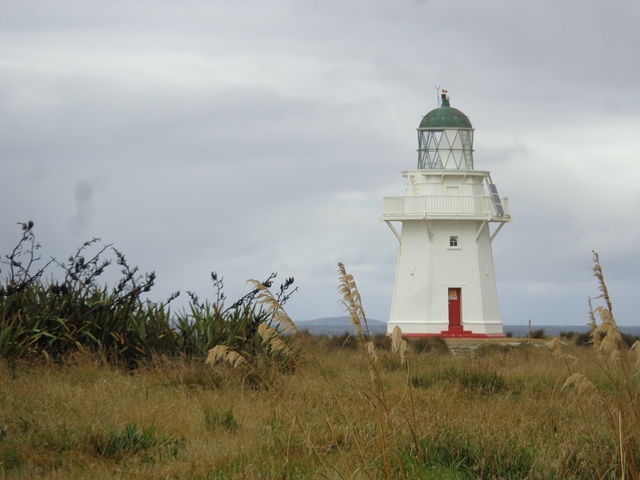
The area is surrounded by a rocky beach and there were sea lions wandering around as well.
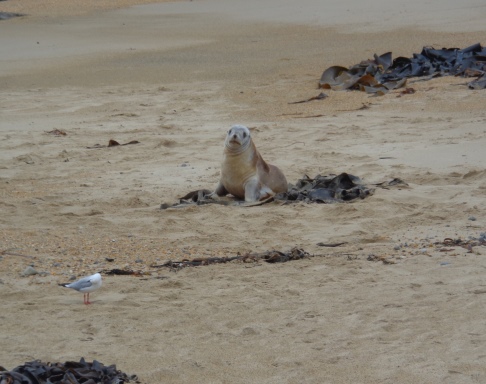

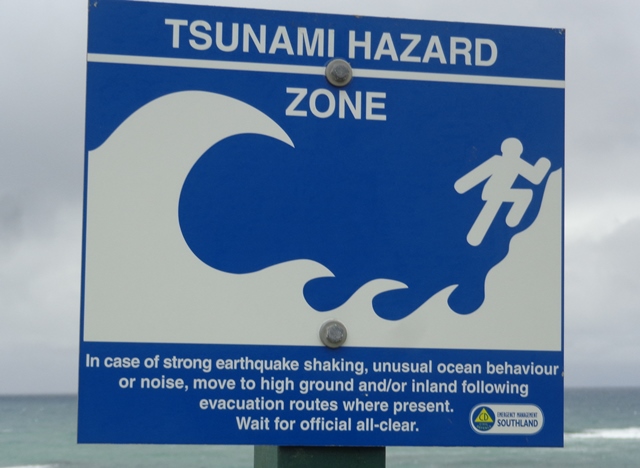
The sea lions look like a lot of fun but there are signs everywhere to stay at least 20 feet away from them because they may not like you as much as you like them. There was also this scary sign:
Certainly one of the highlights of the trip was a visit to Niagara Falls (NZ).

Another sign a little further along warns you not to get your expectations too high.

And here’s the reality. Even I would go over these falls in a barrel!!

A short drive away are the Matai Falls which are a bit more impressive:

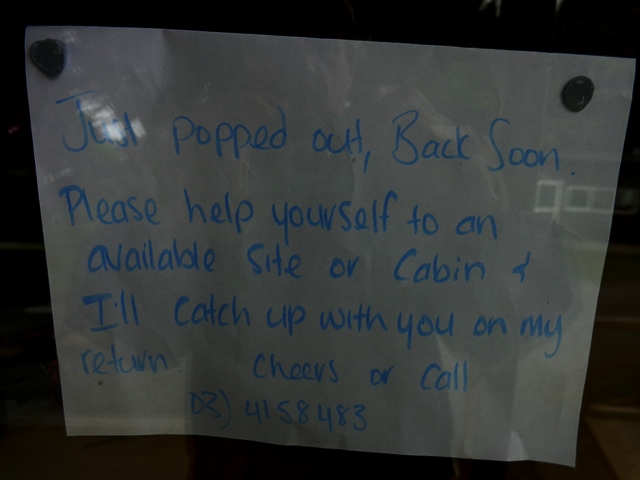
Late in the afternoon we arrived at Pounawea which is located where the Catlin River flows into the ocean. There is no town to speak of, just a few houses and the camp ground where we stayed. When we arrived the office was closed and this sign had been taped to the door:
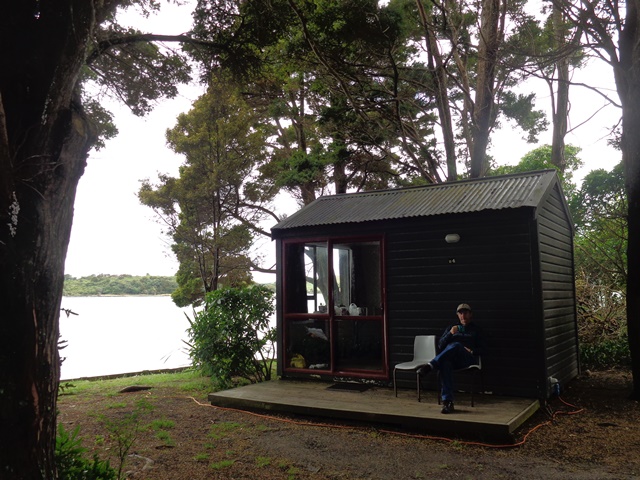
We were staying in a cabin and because we’d stayed at the camp before, we chose cabin ‘B4’ and got settled in. Here I am having the obligatory cup of tea.
And checking out the beach at low tide.
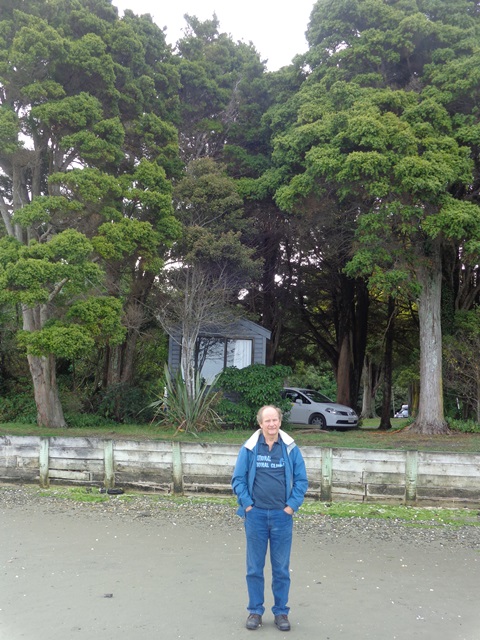
In addition to being right on the ocean, the camp is also in the middle of a nature reserve filled with centuries-old trees.

We spent three days at the camp and explored the surrounding area. Somewhere along the way we had picked up a flyer for a place called “Earthlore Insect Theme Park.” It sounded interesting but debated whether we should go. It was Saturday and it was raining and we thought there might be a huge crowd of kids. We took our chances and when we arrived, we were the only people there!

We were met by Gordon, who along with his wife Jeannine owns and runs Earthlore. On this trip we met many interesting people, but Gordon was certainly one of the most interesting. We ended up spending over three hours at Earthlore and left with a lot of good information and gifts of fresh fruit from his organic orchard.
Gordon and Jeannine are amazing artists who display their work around the Catlins. They gave up careers in Dunedin and bought the property with the original idea of having a unique bed and breakfast in which the accommodation would be gypsy caravans individually built by Gordon. Here is his first effort:

Unfortunately, the local council wouldn’t let them operate as a business because the caravans weren’t wheelchair accessible.
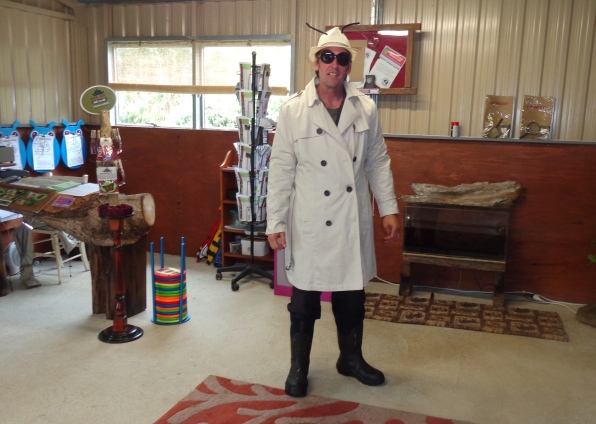
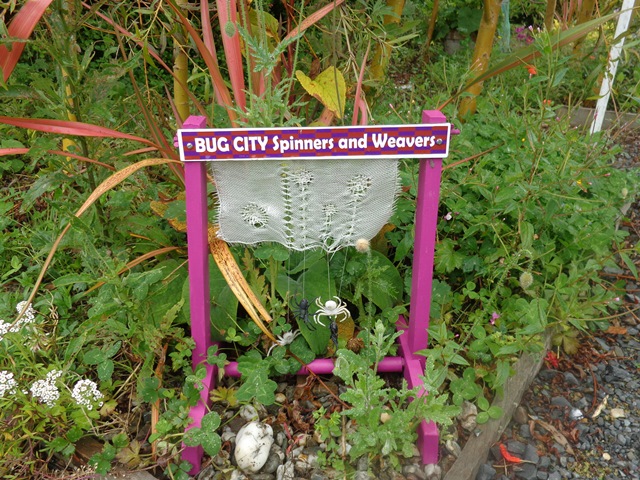
Plan B was Earthlore which in an amazing place where people, but especially kids can learn about insects and their importance to just about everything on earth. The main attraction is something called “Bug City” in which the kids have to solve mysteries by learning bug facts under the guidance of “Inspector Insector.” I like the antennae on the hat.

While there we met another interesting person, William Bisset, who is making a television documentary on the interesting people and the history of Southland. He is travelling through the Catlins with nothing but his clothing and cameras and he knocks on peoples’ doors and asks them if he can stay with them. He works to earn his keep. He is currently staying at Earthlore and helping Gordon with various maintenance jobs. And he is staying in the gypsy caravan!

You can check out a two minute video about his project here or have a look at his web site here.
In addition to interesting people, there was no shortage of fantastic scenery. This is the lighthouse at Nugget Point.
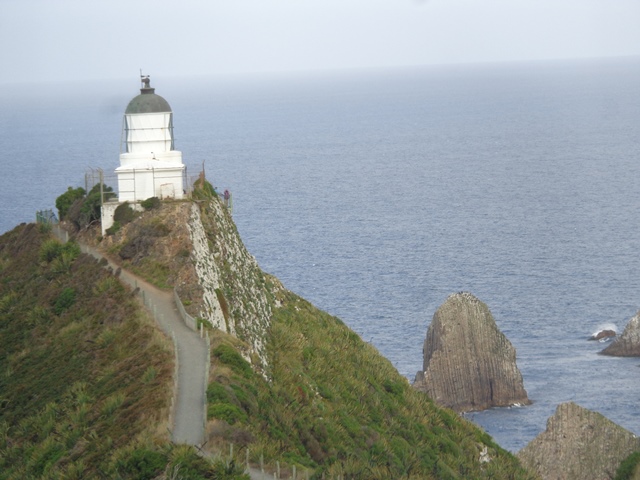
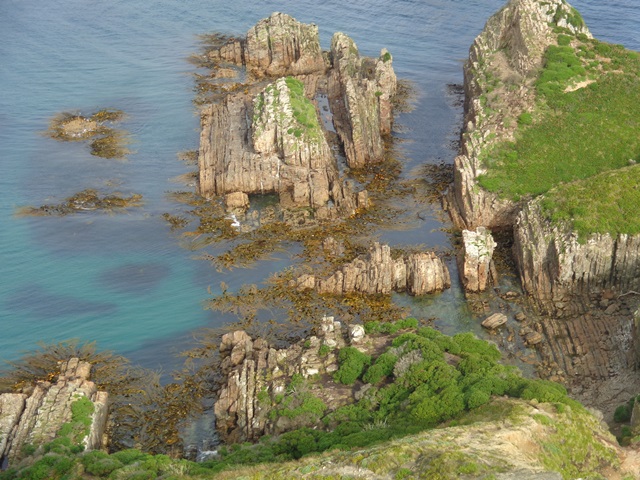
It’s a long walk to the top but worth it. You don’t have to be a geologist to wonder about how those rocks got the way they are.

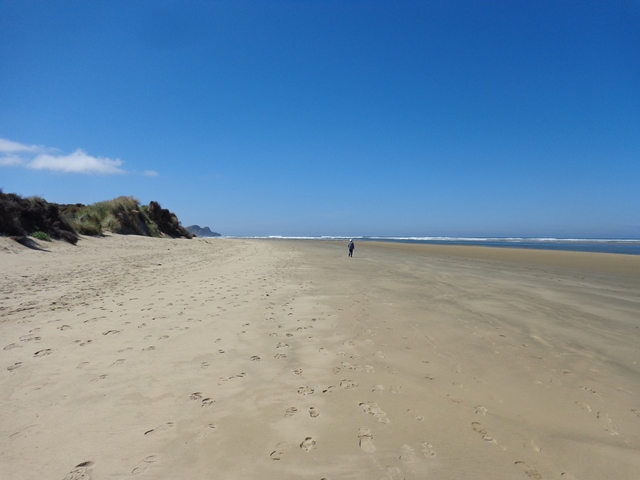
And we had the beach to ourselves at Surat Point, the site of another shipwreck.

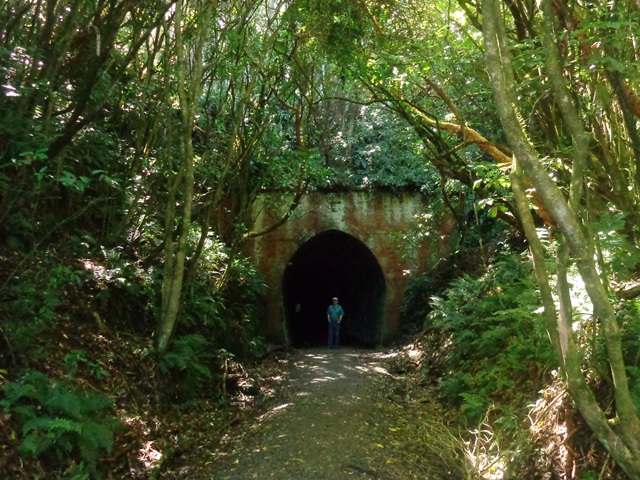
And walked through a spooky abandoned railway tunnel:
After a visit to the ominously named Cannibal Bay, we headed toward Dunedin where we were going to spend the night at a place near the airport for our early morning flight. Some locals told us to avoid the main road and take the coast road. They claimed, and they were right, that the views would more than make up for the fact that the road isn’t paved.
For about 50 kilometres we didn’t see another car but nonstop amazing scenery.
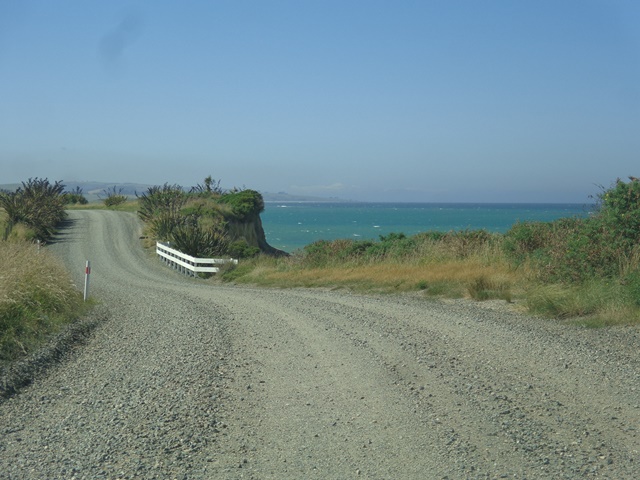

We are hoping that the next time we come back the road will still be unpaved! On the drive home after landing in Auckland I realised I was encountering traffic lights for the first time in ten days. Sort of makes you ready to go back!
A Kiwi Encounter
I have lived in New Zealand for a little over ten years and last Sunday I was privileged to participate in a ceremony that few people experience. Our neighbours at CUE Haven released endangered native kiwi birds onto their property. This is the first time in 50 years there are kiwi on private land in the Kaipara Harbour area and the kiwis released on Sunday are now the closest wild kiwi to Auckland, New Zealand’s largest city.
Most New Zealanders would agree that the kiwi bird is our national symbol. We call ourselves ‘kiwis” and the image of the kiwi bird appears on everything from our money, our soldiers’ uniforms, postage stamps and, in various caricatures, as a symbol of everything from rental cars to quality builders.
Unfortunately, the kiwi is seriously endangered. Before humans came to New Zealand, there was only one indigenous mammal, a small bat, and no snakes or carnivorous reptiles. As a result, many indigenous New Zealand birds, including the kiwi, have no wings. Even birds that fly often spend a lot of time on the ground and nest on the ground.
When humans introduced dogs, cats, rats and weasels, the indigenous bird population was in serious trouble. Today all species of kiwi are endangered. Of the small percentage of wild kiwi eggs that hatch, only 5% of the chicks survive to adulthood. Almost 95% of those killed are killed by dogs.
As a result, most New Zealanders have never seen a kiwi or heard their amazing calls in the wild. There are a number of kiwi refuges on predator free islands or in reserves where predators are controlled, but a kiwi population cannot be sustained without protection from predators.
Our friends and neighbours, Gill and Kevin Adshead have set aside 400 ha (990 acres) of native bush and salt marsh on their 1300 ha (3200 acres) farm, Mataia, http://www.mataia.co.nz/ on the Kaipara Harbour as a native New Zealand forest reserve. They have long dreamt of bringing kiwi back to the Kaipara and that dream became a reality on Sunday 25 May, 2013.
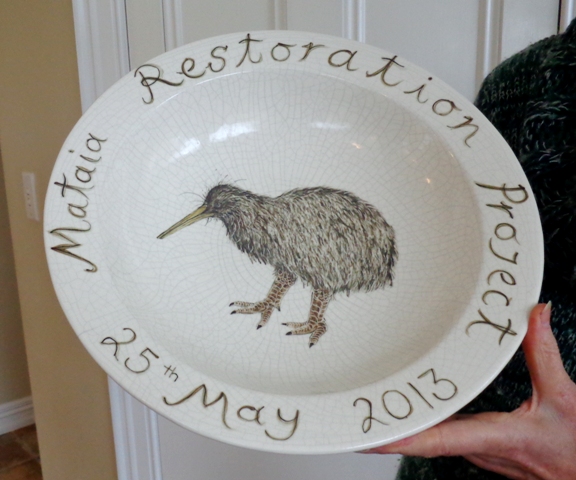
Kiwi are national treasures and highly protected. The Maori, New Zealand’s indigenous people, consider kiwi to be taonga, which means “treasure,” and under the Treaty of Waitangi between the British Crown and the Maori tribes, Maori have kaitiakitanga (guardianship) of their taonga. Also, the Department of Conservation which manages kiwi reserves will only release kiwi in environments that they are satisfied to be suitable and safe.
Since 2006, Gill and Kevin have undertaken an intensive pest and predator control program to eradicate possums, stoats, ferrets, weasels, cats and rats on the Mataia property. They also fenced their entire property and covered it with shade cloth that will keep the kiwi in and defeat most predators including dogs. Only working farm dogs that have undergone kiwi aversion training are now allowed on to the property. Once all safeguards were in place, it was decided to release fourteen kiwi onto the property.
A specially trained team from the Department of Conservation and Auckland Zoo and two family members spent Friday night on Maturangi Island, a kiwi reserve, to trap fourteen Northland Brown kiwis. Kiwi are nocturnal and only come out at night. It was a full moon so unfortunately not many kiwi came out of their burrows and so despite the team walking around the island several times from 8 pm to past 5 am they were only able to catch five kiwis. These were brought to Mataia on Saturday morning. The team will go back in a few days to catch the remaining nine kiwi.
Because the kiwis were being transferred from one Maori tribal area to another, it was necessary for the gifting iwi (tribe) to introduce the kiwis to their new home and for the iwi that would be receiving the kiwis to formally accept them. On Saturday morning Maori representatives from the iwis were at Mataia to do the Pôwhiri (formal welcoming ceremonies) and the event was attended by almost 500 guests.
It was a fascinating morning. Three schools in the area and the local community had helped support the kiwi release project and several students, teachers and parents along with neighbours, friends and local government representatives came for the day. There was also a lot of media coverage as it was over 50 years ago that the last kiwi was seen in the Auckland region.
It was first necessary for there to be a formal welcome of manuhiri (visitors) to the Mataia property by the local iwi, Ngati Whatua o Kaipara, and Gill & Kevin’s families. My wife and I were honoured to be considered part of Gill and Kevin’s family. The manuhiri assembled at the entrance to the Mataia Homestead and were welcomed by the Kuia (female elder) from the local iwi with a karanga (call) and invited to take seats across from where tangata whenua (local people) sat.
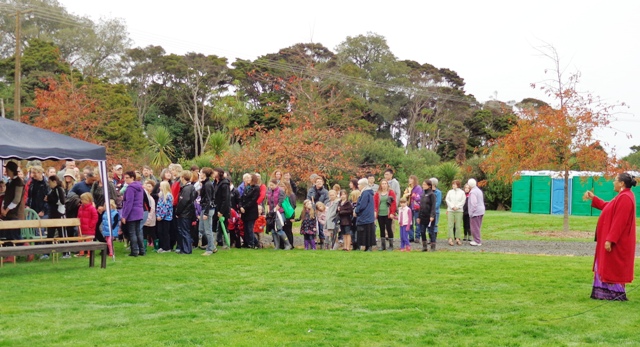 The local iwi kaumatua (elder) then welcomed everyone and gave a speech explaining whakapapa (the genealogy) of the local tribe and the local area. The speech was in Maori followed by an English translation.
 The Department of Conservation representative then gave a speech in response on behalf of the kiwi sanctuary. This speech was followed by a speech from the representative of the manuhiri explaining who they were and their background.
 The purpose of these speeches was to help establish the identity of the various groups and demonstrate that they are present for a peaceful purpose.
The local Kaumatua then invited the mahuhiri for the hariru (shaking hands) and hongi (touching noses together). This is a symbol of love and peace because at creation, the breath of life was breathed into the nose. The tangata whenua and the manuhiri then got acquainted over morning tea.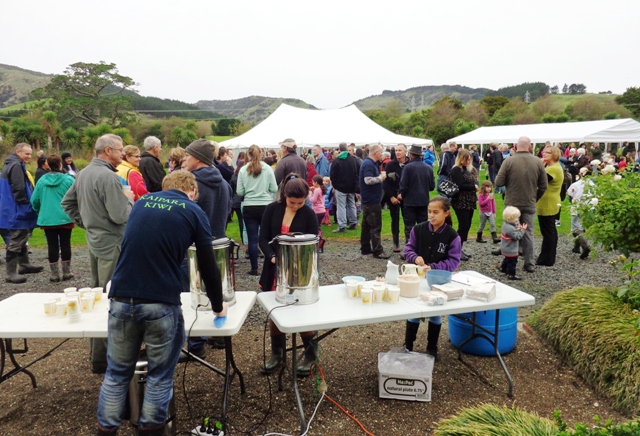
 Now that the people had all been introduced and welcomed, it was time to welcome the kiwis to their new home as honoured guests.

The local tangata whenua welcomed the kiwi with a speech by the kaumatua and waiata (special welcoming songs) by the local school children.
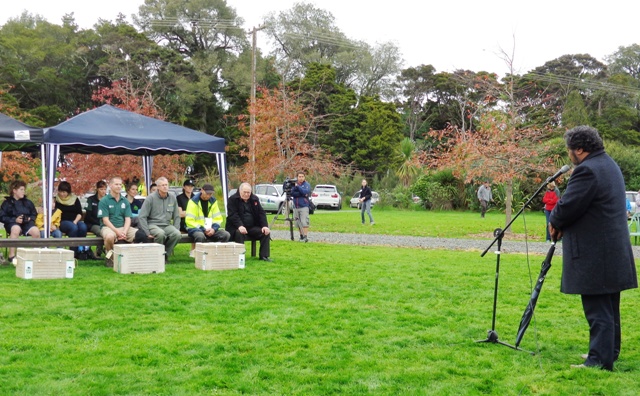

 Gill’s family has owned Mataia since 1870 and her oldest brother also welcomed the kiwi and the visitors and gave a short history of the Gardner family and the Mataia Restoration Project.
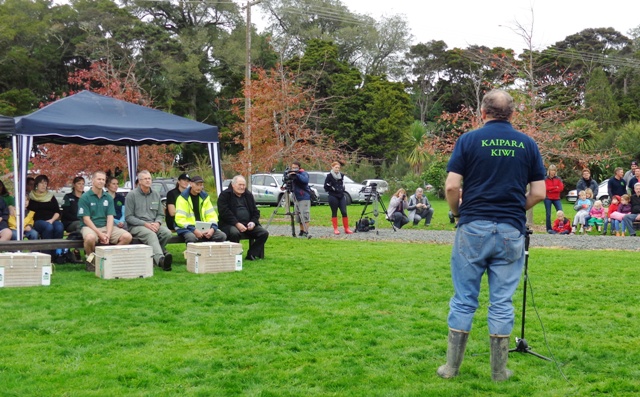 Then the representatives of the gifting iwi and the Department of Conservation gave speeches explaining the background of the kiwi and their lineage and formally presented the kiwi to Mataia.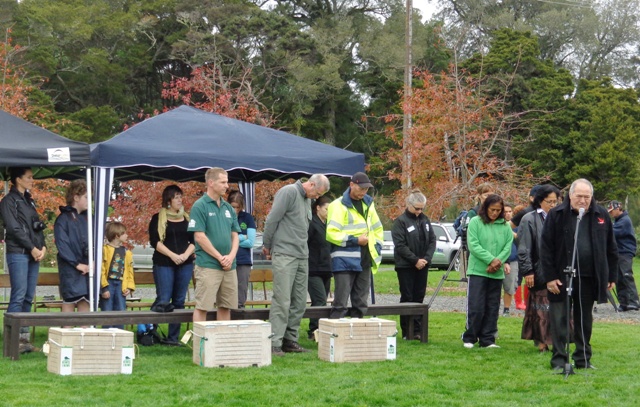
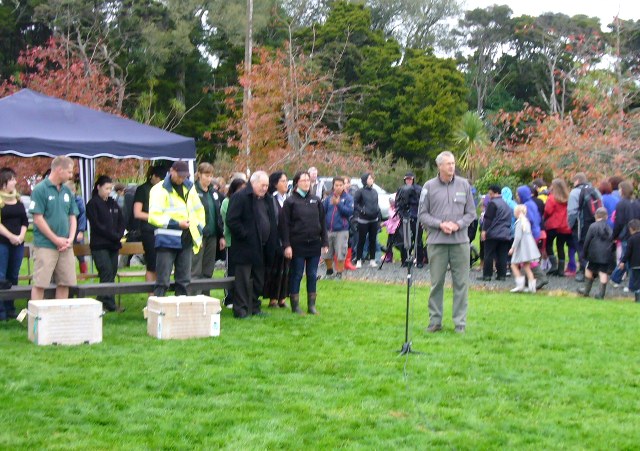
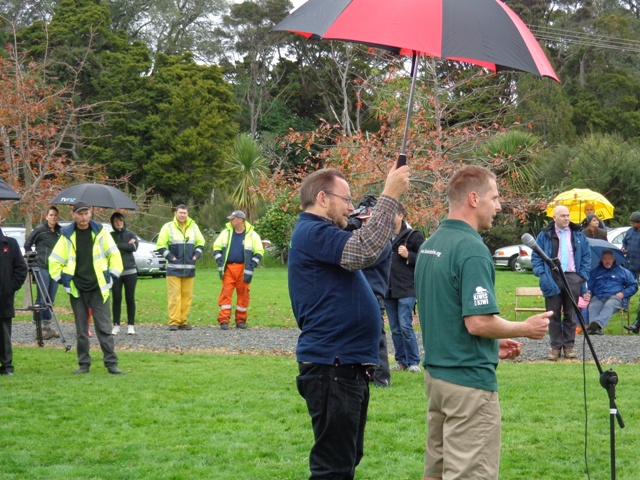 The kiwi were blessed by the local kaumatua and formally named and introduced to the community.
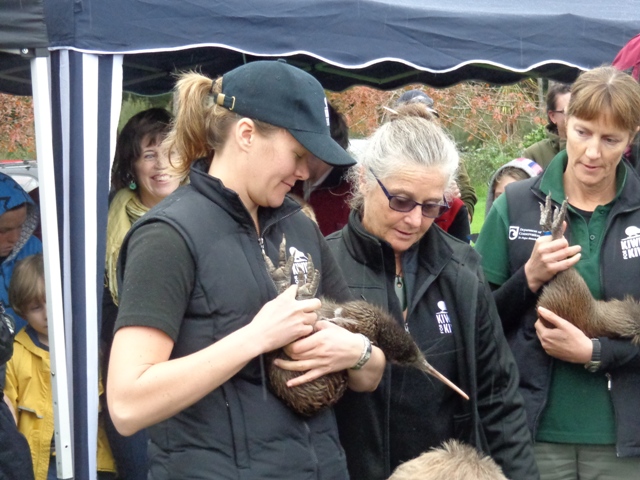
 While guests were having lunch the actual release of the kiwis took place deep in the bush and that was handled by the Department of Conservation experts accompanied by a few students and family members.
Previously, Gill and Kevin had put temporary wooden burrows out for the kiwis. The birds were transferred to those boxes and at night the boxes would be opened for the kiwi to explore their new home.
Each kiwi is fitted with a transmitter so that their movements and health can be monitored.

We were very happy and honoured to be part of the very special celebrations and ceremonies and welcome the return of kiwi to the Kaipara Harbour. More kiwi will be released at Mataia in the following week.
CUE Haven is less than a kilometre from Mataia and we are hoping that in the not too distant future, CUE Haven too will be hosts to kiwis.
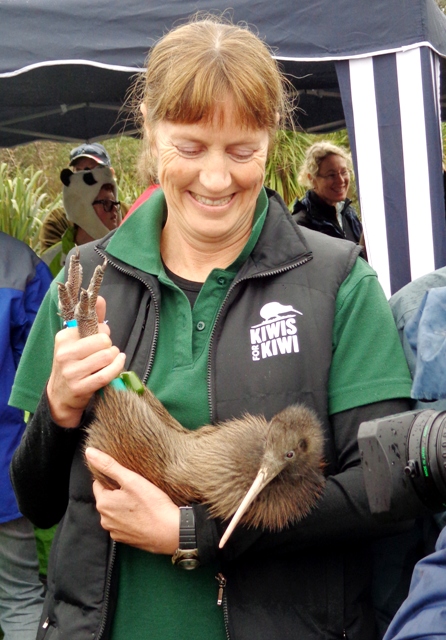
The event was covered by the New Zealand media and you can see the news clips here and here.


 testazyk.com