Australian Rain Forests
We haven’t done much exploring outside of New Zealand lately so we decided to take advantage of some cheap flights and flew to Cairns in northeast Australia to explore the Daintree Rainforest and Atherton Tablelands, all within easy reach of Cairns.
This is the area we explored.
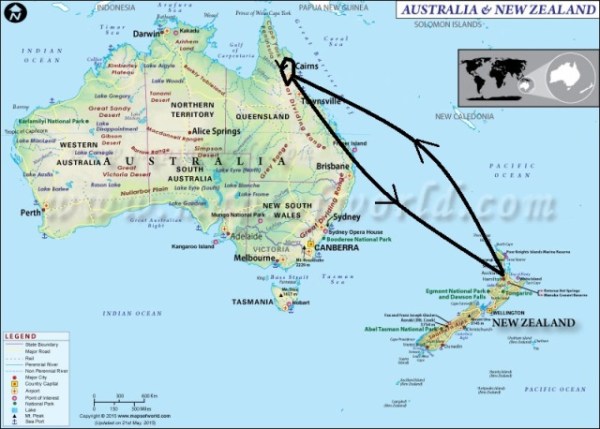
I didn’t know what to expect. My earliest images of Australia were based on The Road Warrior and Crocodile Dundee and I imagined lots of desert and open spaces. Since then I’ve been to the big east coast cities like Sydney, Melbourne and Brisbane and was always surprised how green everything is.
But nothing prepared me for the rainforests we visited. They call the area the “Wet Tropics.” They are well named. It was the “dry season” but it rained every day we were there. And yes, there are poisonous snakes and spiders. And leeches.
But don’t get me wrong. It was beautiful and amazing and fortunately we didn’t get a single mosquito bite.
We picked up the car in Cairns and headed north. Cairns is on the coast of the Coral Sea and is the gateway to the Great Barrier Reef. The road up north mostly follows the coast.

After a couple of hours you come to the Daintree River.
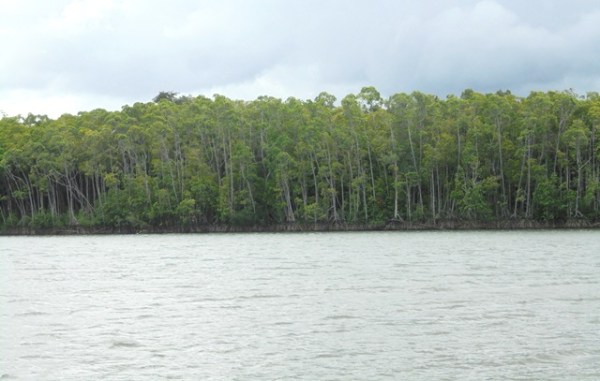
There is no bridge, only a ferry which will take 27 cars at once.
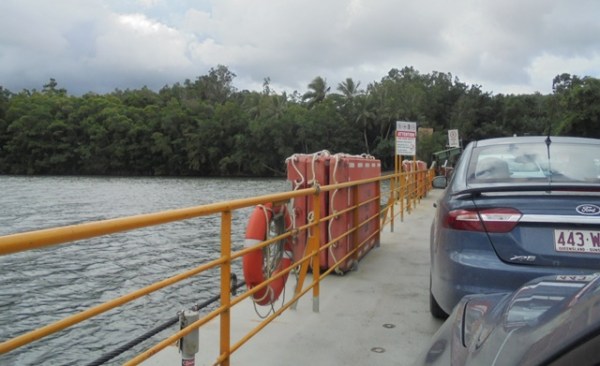
As soon as you get off the ferry you know you are in the rainforest.

Our first couple of days we stayed in a place called Cow Bay. It is right on the water but you don’t know it because the rainforest goes right down to the shore. The place we stayed was called Crocodylus, which wasn’t very reassuring. That is the Latin name for the saltwater crocodile which lives in the estuaries. As recently as May someone was eaten by a crocodile at Cow Bay and it’s a good idea not to ignore the warnings.

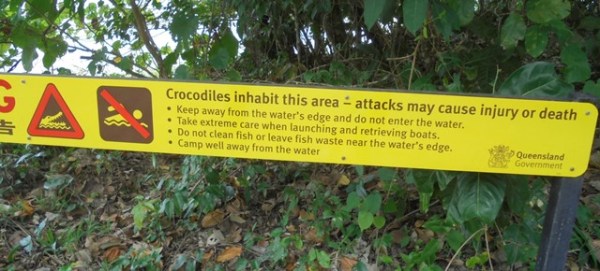
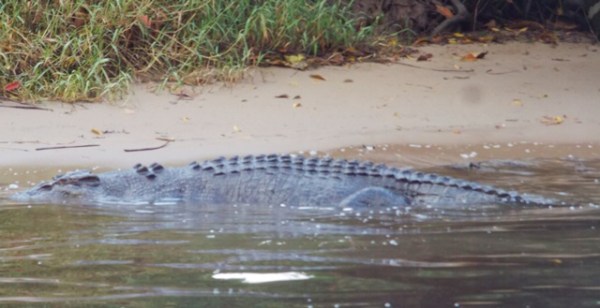
We did see a crocodile on a boat ride and from the way the skipper behaved I could tell he had a lot of respect for it. This one is 4 metres or about 12 feet long.
The Daintree area is sparsely populated and we really enjoyed meeting some of the locals, who were all interesting characters. The farthest north we got was Cape Tribulation. It got its name because Captain Cook ran into trouble there. Captain Cook named a lot of places in Australia and NZ and he was very imaginative. In NZ we have Poverty Bay, Doubtless Bay and Cape Foulwind.
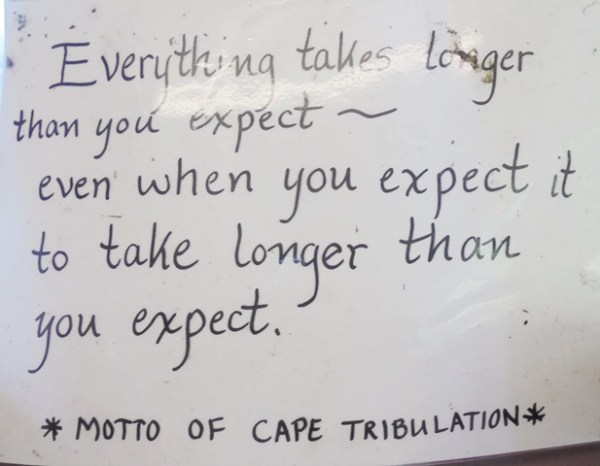
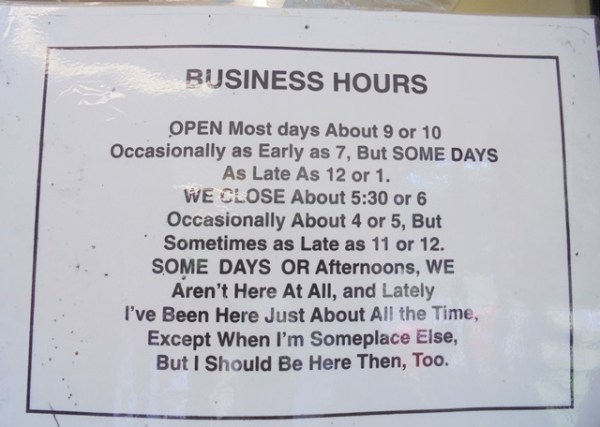
The local cafe at Cape Tribulation, which serves crocodile, kangaroo and emu burgers, is a nice laid back place and had some interesting signs.
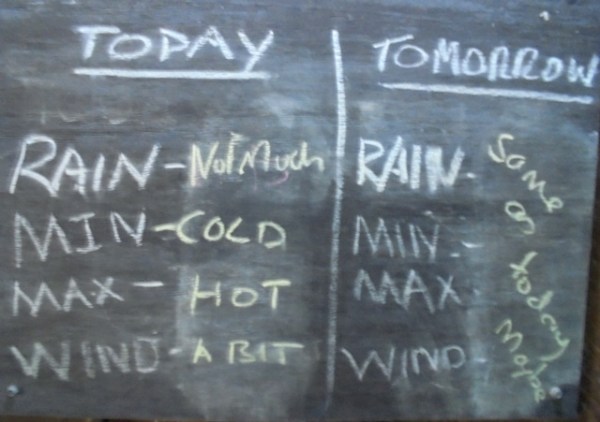
And here is the helpful weather report provided by the front desk at Crocolylus.
Speaking of which, this was our accommodation at Crocodylus. We wanted to be in the rainforest and got our wish.


We also stayed at places on the Daintree River and in the Atherton Tablelands that were very close to nature.
The main attraction at all these places was the rainforests and the animals.
First of all, though, let me clarify a few things. Rainforests are essentially forests that exist in areas of high rainfall. Because of the conditions they usually have a variety of plant and animal life. A lot of the rainforest in the areas we visited is recovering after being cleared but there are areas of untouched forest and the entire area is a World Heritage Site.
Rainforests are not for the faint hearted. They are never quiet, but at dawn when the birds start their day they are positively noisy! And the variety of birdcalls is amazing. There are also, at least in these rainforests, a lot of things that you don’t want to encounter like poisonous snakes, spider and centipedes. One of the biggest dangers, however, is wild pigs.
We did a lot of exploring – walking on all sorts of paths from the luxurious —
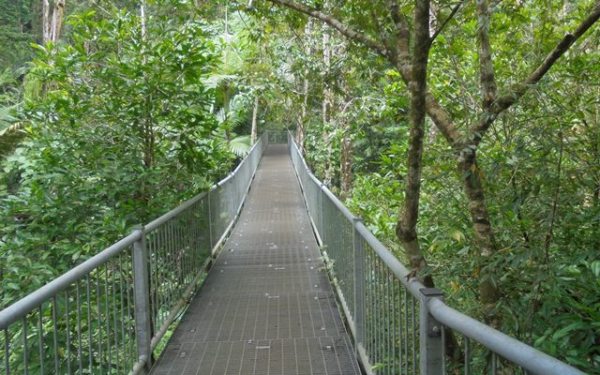
To the scary–


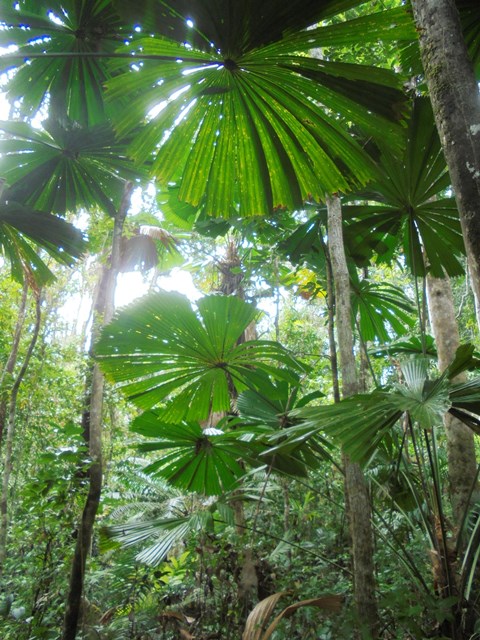
We saw lots of interesting plants.

This is called a fan palm.
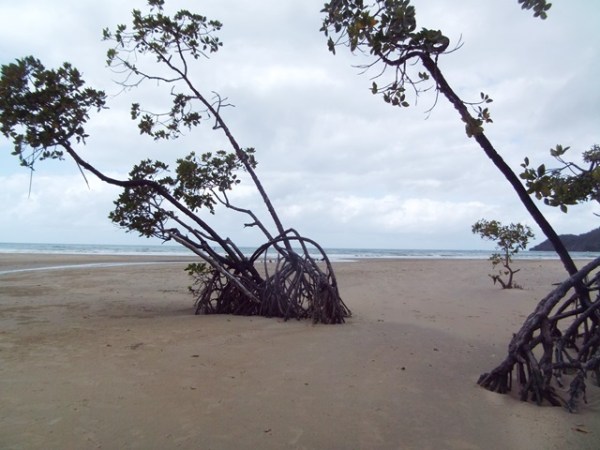
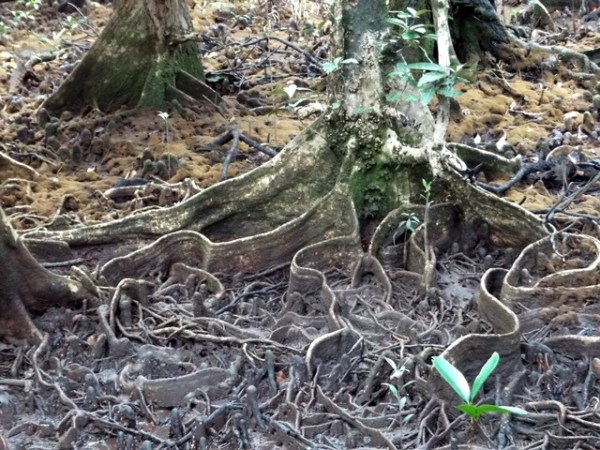
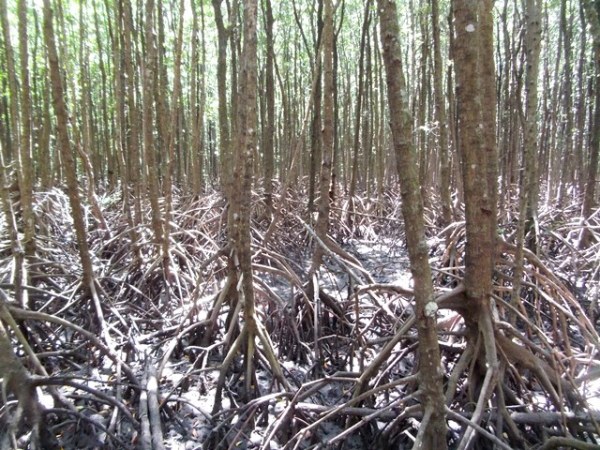
Where the rainforest meets the ocean there are mangrove swamps in the estuaries and the mangrove trees and roots sometimes look like something from outer space.
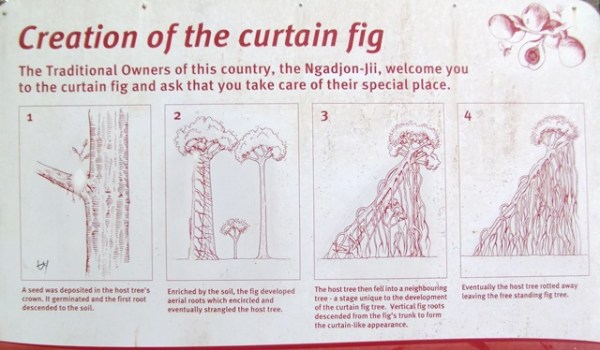
One of the most amazing trees we found is the strangler fig. It originates from the seed of a normal fig tree but when a certain wasp lays its eggs in the seed and carries it to the top of an existing tree it can germinate and send airborne roots down to the ground. The roots harden around the host tree and eventually kill it. When the host tree dies, the strangler fig appears hollow.
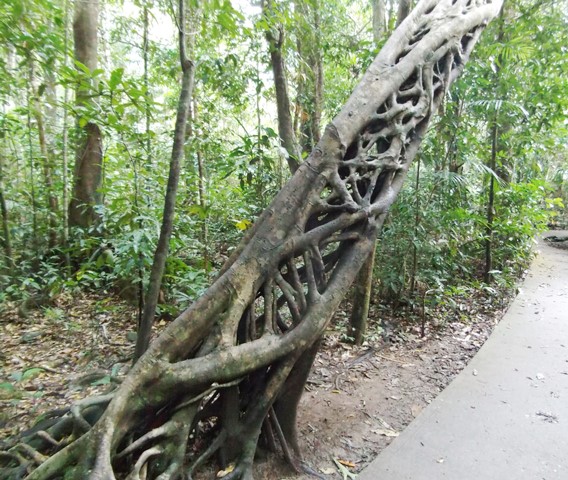
When the seed lands at the top of a huge old tree and the fig has been growing for a long time, the results can be amazing. This one is called the Curtain Fig. At some point in the process the host tree fell against another tree and the strangler fig roots have created a “curtain.”
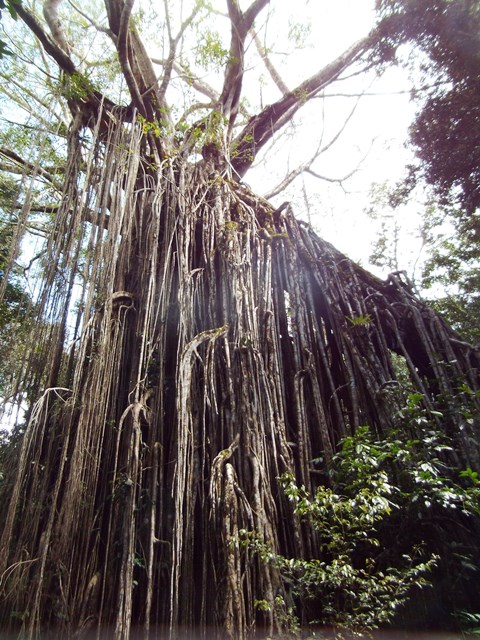

This one is called the Cathedral Fig. The canopy is 1,250 square metres and it is estimated to be over 500 years old.
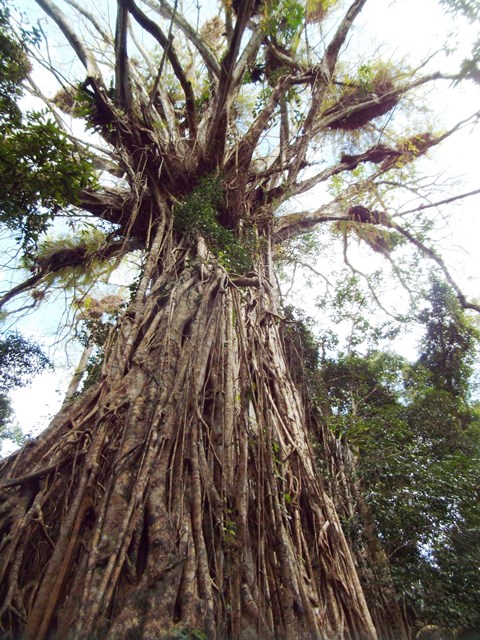
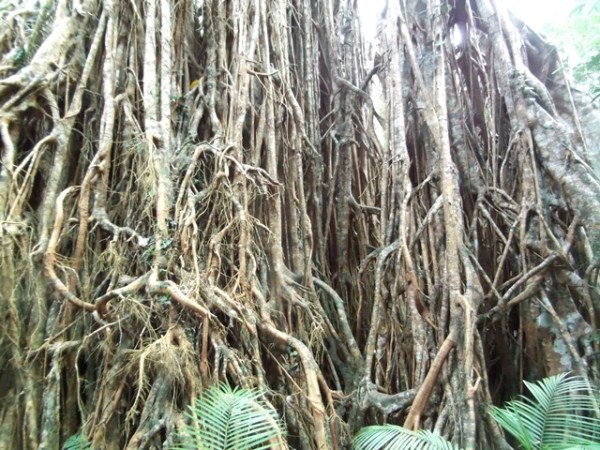
Care for another fun fact?
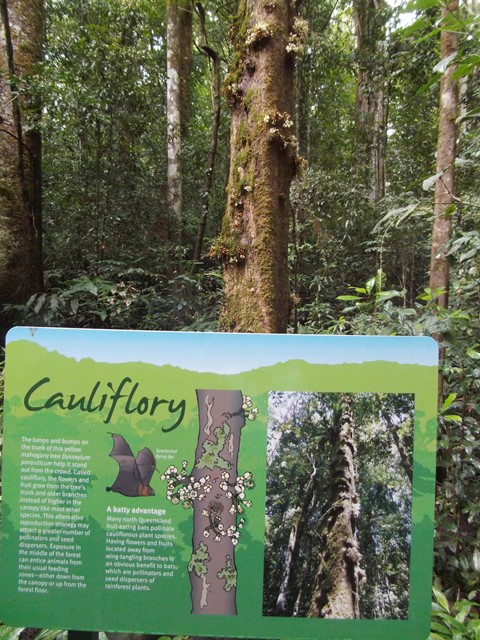
We didn’t know this, but in this part of Australia there are no native bees to help plants pollinate. And because birds, who are also pollinators, don’t like flying from flower to flower in dense foliage where they can’t spread their wings, Australian trees have developed flowers on their trunks instead of in the branches. This way insects and other creatures walking on the trunk will pollinate the flowers. The characteristic is called “cauliflory” and you can see the flowers on the trunk of this tree.
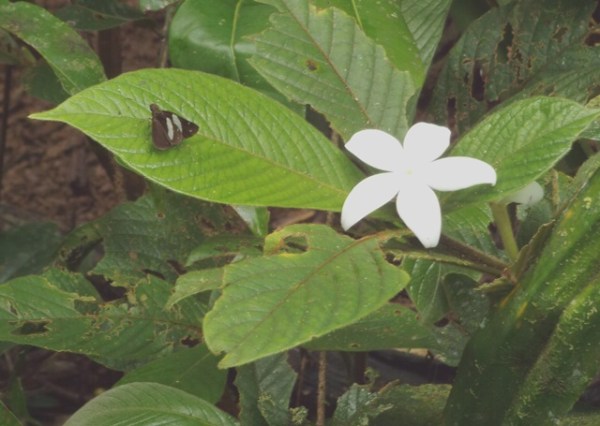
Here is a rainforest flower related to the gardenia.
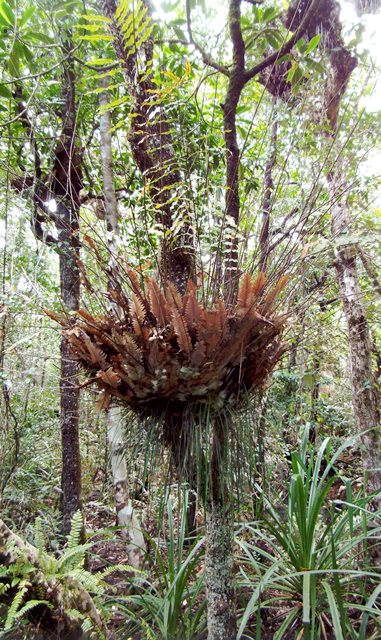
And here is something called a basket fern which grows high up in trees and is a ready made home for birds, snakes, frogs, insects and even other plants.
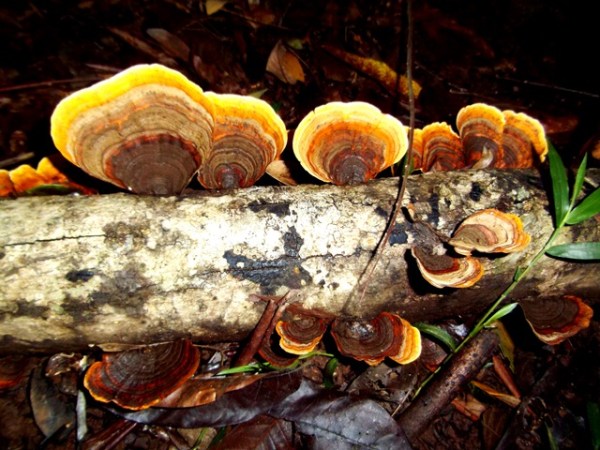
And some pretty glow in the dark fungi.
These are flowers of the jade vine.

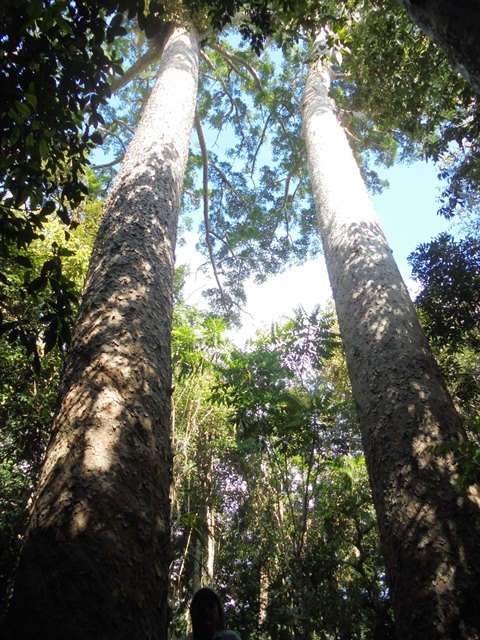
And here are two of the few unlogged Australian Kauri which are cousins of New Zealand’s largest tree.
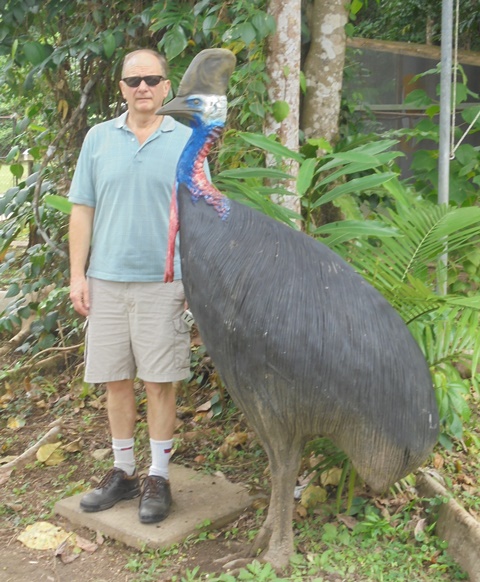
In addition to the new and interesting plants, we also enjoyed the unusual birds and animals. The big draw in the area is the cassowary which looks like a cross between an ostrich and a dinosaur. This is how big the females can get and although we didn’t spot any real ones the advice is to give them a wide berth because they have a bad temper and sharp beaks and claws.
We did however see some paddy melon wallabies and kangaroos.

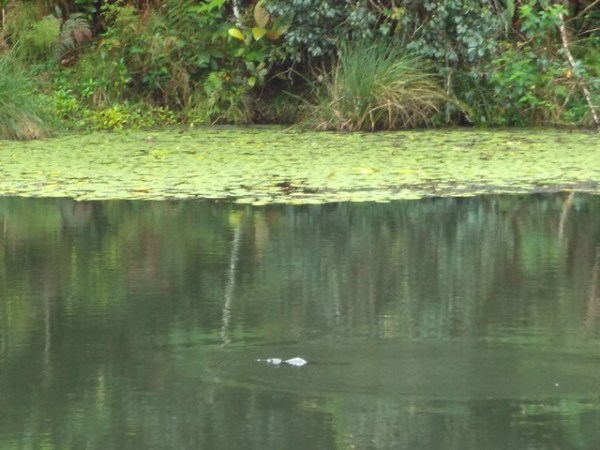
This is a platypus in search of food.
We went for an interesting night walk in the forest and saw a lot more than we could photograph. There were centipedes and spiders and cane toads which are poisonous. It was especially worrisome when a huge centipede jumped across the path in front of us and our guide said, “I didn’t know they could do that.”
If things didn’t move too fast we were able to get pictures. Can you spot the interesting cricket with the long antennae trying to camouflage itself on a stick?

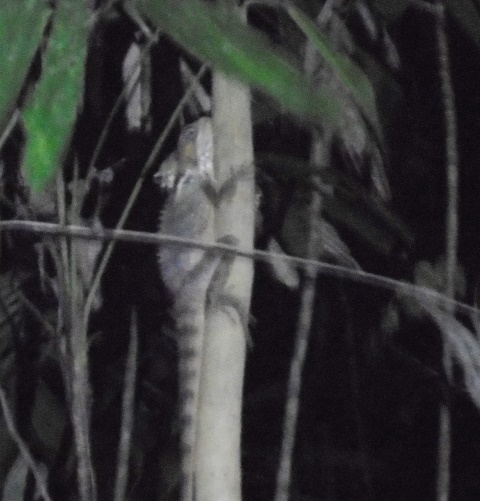
Here is a Boyd’s Forest Dragon.
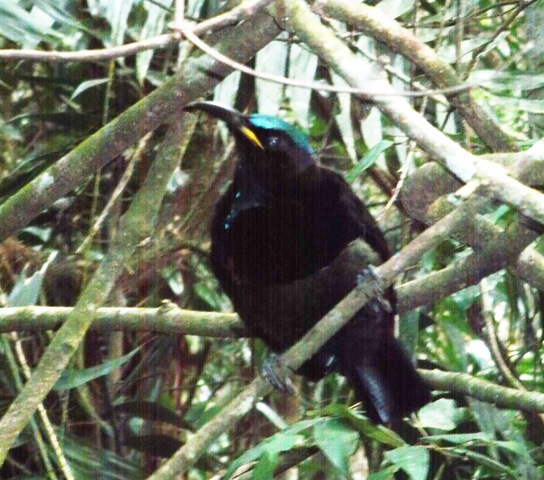
The rain forests here are also renowned for the variety of birdlife. We heard and saw lots birds and almost all of them were new to us like the Victoria’s Riflebird and Golden Bowerbird below.
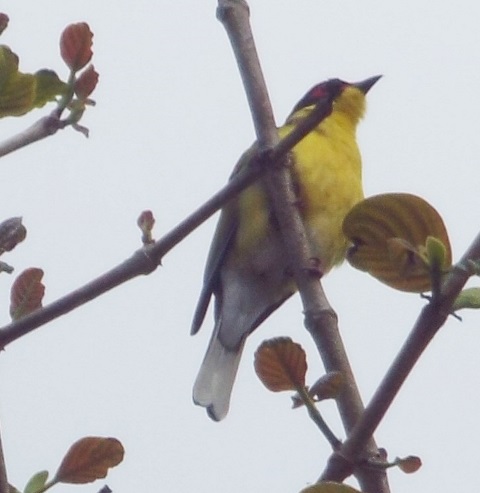
While on a dawn birdwatching tour on the Daintree River we saw some more very interesting and colourful birds
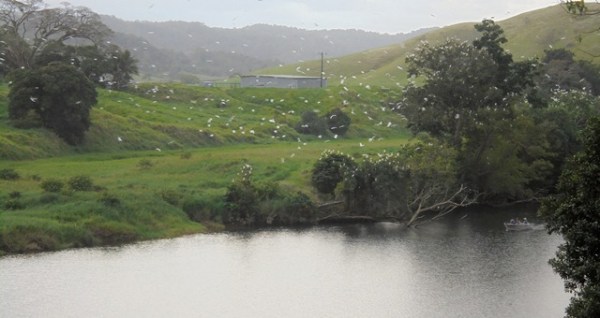
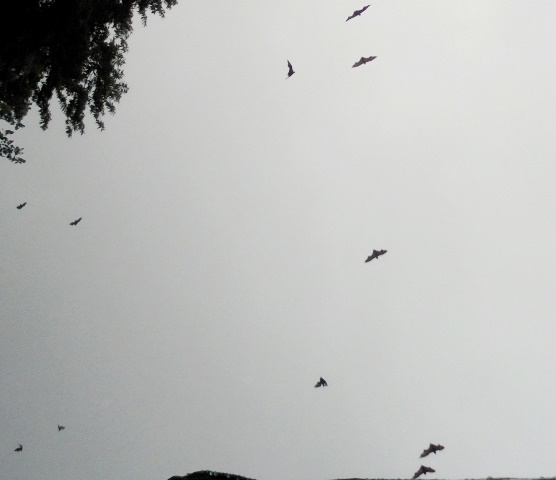
. . . and giant bats known as flying foxes — their wingspan is a metre wide.
At the Hasties Swamp National Park in the Tablelands, we couldn’t believe the number and variety of ducks as well as swans and pelicans.


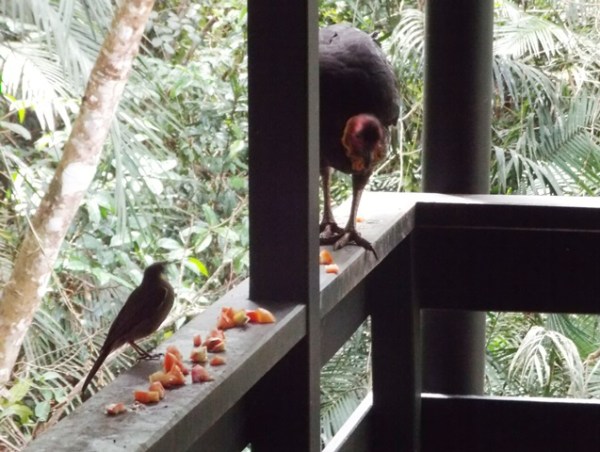
The last place we stayed was by Lake Eacham in the Atherton Tablelands, and our lodging was also set in the midst of a rainforest. The owners here encourage the guests to interact with the animals by leaving fruit for the birds on the cottage porch. Each morning we put orange and tomato pieces out on the railing and got lots of visitors. The big bird is the bush turkey and the little one is Lewins Honey Eater.
This place also had a lighted viewing platform where at night they put honey on a couple of trees to attract animals. The animals are too busy eating to pay attention to the people taking their pictures.
This is a striped tail possum:
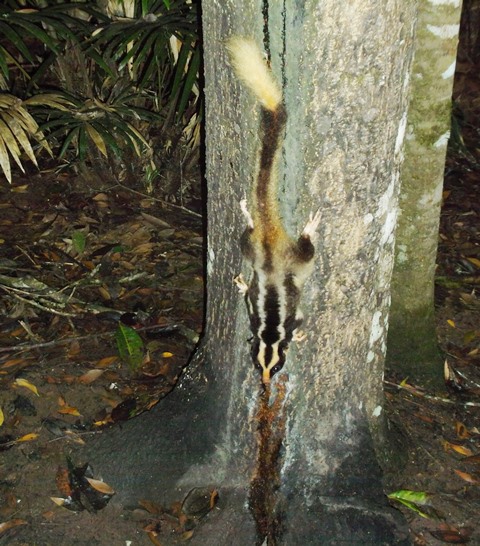
Here’s a sugar glider:
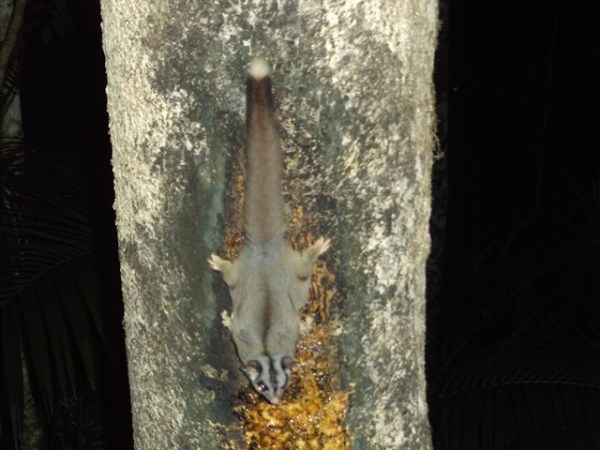
And a long nosed bandicoot:

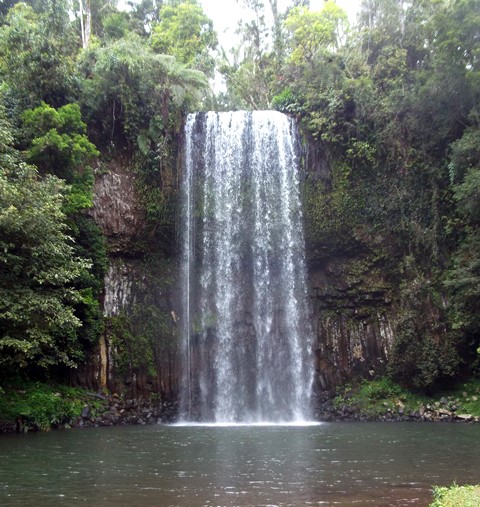
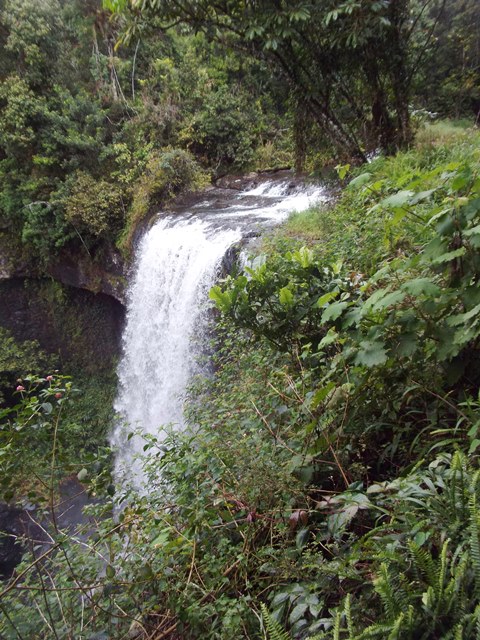
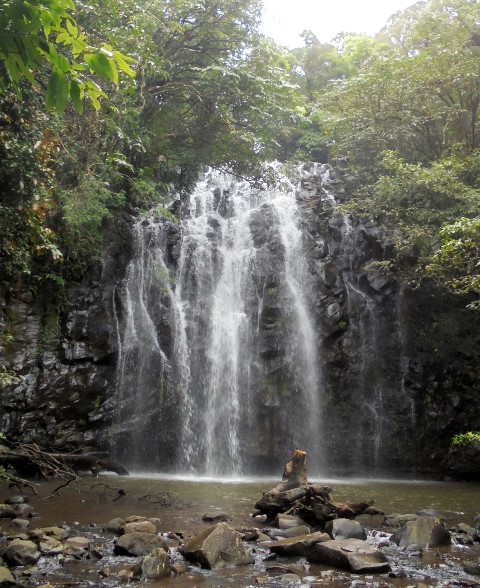
The Tablelands area is quite volcanic and has many beautiful waterfalls. We spent a morning exploring the Millaa Millaa Falls circuit which is circular road that takes you to several waterfalls in the area.
This is Millaa Millaa Falls, looking just like a waterfall should!
This is Zillie Falls.
And here is Ellinjaa Falls.
There were never ending interesting things along the way. I wasn’t sure to laugh or cry about this sign at the base of a tall tower that you could climb up for a panoramic view of the rainforest canopy at the Daintree Discovery Centre.
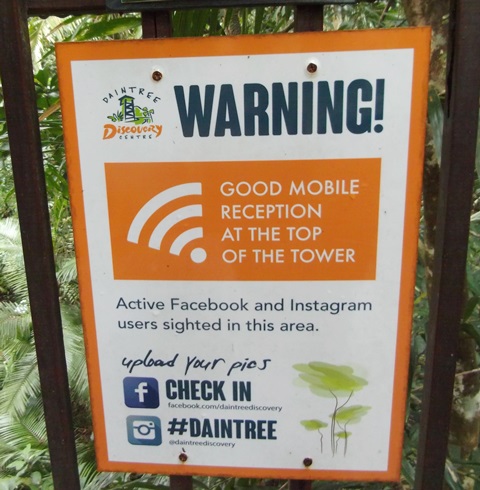
Be glad that I’m sparing you a selfie from the top of the tower!
We’d heard about the problems with jellyfish on Australian beaches and it’s no joke:

They actually have a bottle of vinegar in that little tube which you are supposed to spill on stings.
It wasn’t all wilderness. We visited a number of little towns. One of our favourites was Yungaburra. It has a population of 1,100 and several heritage buildings, including this one that looks iconically Australian to me.

There were a number of whimsical shops. At the Mad Hatter Café everything is Alice in Wonderland themed.
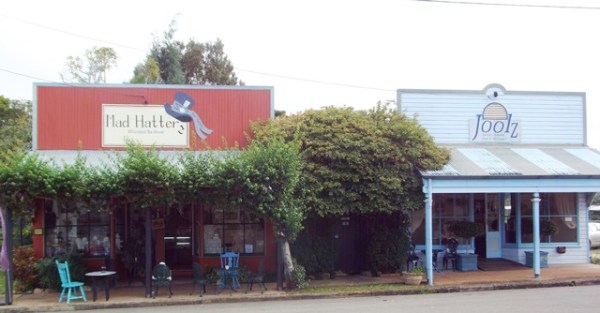
And they have an interesting community arts centre.
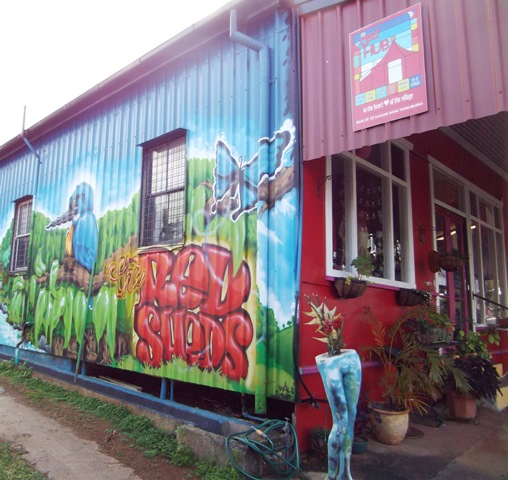
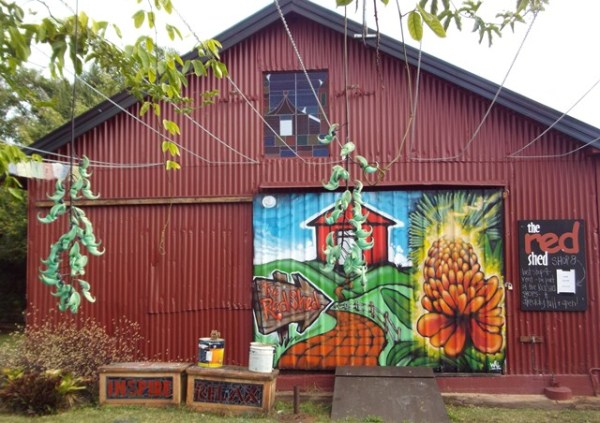
We also did a bit of non-tourist stuff. The School for Field Studies Centre for Rainforest Studies is located in the Atherton Tablelands and each year for the past three years, Dr. Amanda Freeman, centre director, and several students and faculty have visited New Zealand and stayed at CUE Haven and helped us with our restoration planting.
We didn’t exactly return the favour because we didn’t do any work, but we spent a nice day meeting up with old friends and seeing their facilities.
We met them at a community nursery operated by TREAT (Trees for the Evelyn and Atherton Tablelands). The SFS team was helping out in the morning with a community working bee. Volunteers from the area grow and nurture the trees until they are ready to be planted and then participate in community planting days to restore and extend the rainforests. It was very interesting talking to the volunteers and learning of their efforts to restore their rainforest.
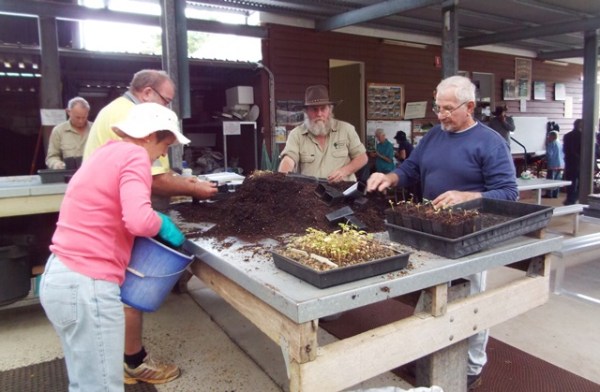

We then went over to the SFS centre for a tour and to meet the rest of the staff and students. Amanda showed us some of the research and experiments they are working on to see how to improve the effectiveness of rainforest restoration.

The next day we headed back to Auckland. It was a short but very interesting and enjoyable trip. We learned a lot and met some great people and we look forward to exploring more of Australia.


Farm Adventures—They Just Keep Coming
Over the years I’ve told you stories about the farm project, most of which involve me ending up somewhere out of my comfort zone as a result of interaction with large and small creatures and machines.
Please be assured that silence doesn’t indicate the absence of thrilling (at least at the time) stories. Like the autumn mouse invasion or the three day effort to get the neighbor’s cow off our property after it snuck through a gate.
But in the past couple of weeks we’ve had a new adventure that no one saw coming. After a rainstorm of Biblical proportions, a section of the neighbor’s hill let go taking the boundary fence and a couple of thousand trees that we’d planted in 2015. The laws of physics were working overtime and the landslide kept going across a service road and out onto flat ground in the wetlands.

And here is the “road.”
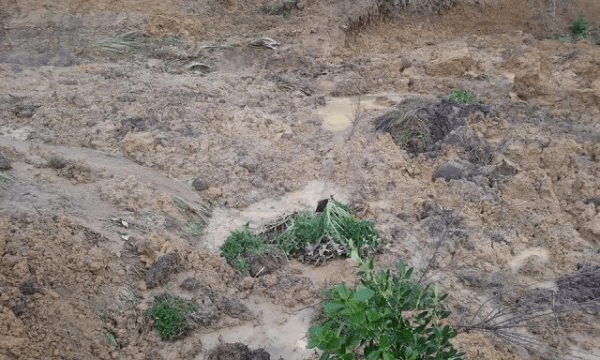
Fortunately no one was around (although it might have been cool to watch it from a safe distance if only to find out what kind of noise it made).
Our amazing volunteers have already offered to come out to replant the area, and we will do that next year once the area has dried out. The more urgent problem was the blocked road. The mud was waist deep and that’s about how far you would sink if you tried to walk across. So what was a short walk/drive before, was now a big detour by another road.
Getting the road fixed was a priority so we called Peter, the guy who does our roadworks to see what it would take to fix.
One of the things we’ve really enjoyed about this project is the fascinating people we have met and Peter is one of the most interesting. His resume is a bunch of cool jobs that I didn’t even know existed but which have involved interaction with hammerhead and great white sharks and all sorts of other menacing four and two legged creatures. He’s now got this earthmoving business and in addition to the roadwork at our place he’s always been happy to help out with advice on maintenance problems since he also has a lot of experience as a mechanic.
It should come as no surprise that Peter is a veritable font of hilarious stories about everything. And he has the most colorful way of expressing himself both with rich vocabulary and amazing phrases filled with impossible grammatical constructions to describe impossible anatomical rearrangements or juxtapositions to which he would like to subject government officials, politicians, neighbors or anyone else who disrupts the logical flow of life.
We called Peter and he agreed to come out the next day to have a look at the situation. He decided that it was still too dangerous to go into the slip area but he would be able to clear the road and also improve the drainage (an impromptu lake had formed) in a few days.
We met Peter early morning one day last week and he went to work to clear the mud blocking the road. At midday he joined us for lunch at the cottage and it was a nice winter day so we were sitting at the tables outside. He regaled us with stories about land slips and some of his adventures. I didn’t think it was possible for a tracked vehicle like a digger to lose traction but he described slaloming down the side of a hill for about 100 feet one time.
Needless to say, it was a fascinating and hilarious story with gravity, physics, the digger, Isaac Newton, the digger manufacturer, and the landowner and a few other people and organizations all being subjected to a tirade of amazing length and lots of subordinate clauses as he described his thought process about how long it would take to stop and what condition he would be in when he did come to rest.
He interrupted the story for a minute (not to take a breath–he usually doesn’t do that when he’s on a roll) but because a car was roaring down the public road with a highly modified exhaust system that made it sound like the startup of the Indianapolis 500.
Once the roar had subsided, Peter didn’t continue his narrative. Instead shook his head and said with a tone of professional authority, “There’s a man with SPS.”
Now, because Peter worked as a mechanic, I assumed that an SPS was some sort of esoteric vehicle or vehicle modification that enabled his car to sound like an A360 taking off.
So I said, “SPS? How does it work?” He laughed and said, “No. SPS is ‘small penis syndrome.’ You show me a guy with wheels like that and I’ll show you a guy worried about the size of his willy.”

I’d never thought of it before but it made perfect sense. And even though we were paying Peter by the hour, we had an extended lunch in which we talked about the applicability of the SPS theory to other walks of life besides cars. And believe me, there are a lot of examples!


 testazyk.com