The Top of the South Island—February 2015
I know. There’s no excuse. I haven’t posted anything since our last trip and here I am writing about another trip.
It’s not like there hasn’t been a lot to talk about. It’s just that the stuff that’s going on sort of speaks for itself. I have nothing to add. For example, I’d really like to weigh in on the subject of the 20 year old American guy who was gored rather publicly at a bull running festival in Spain. You want to ask what he was doing there and why. But once you see the pictures and think ‘Oh my, is that where he got it?’ and then you read that the surgeon said that the guy needed surgery “to repair his sphincter,” you realise that silence is the best policy.
Or the story about the cat that got hit by a car and was presumed dead by its owner and buried. It turned out it wasn’t dead and crawled its way back home. The so called ‘zombie cat,’ which is now the center of a ‘custody battle’ between the owner and the local animal shelter is getting more press coverage than Greece, Libya and other global hot spots combined.
How can a rational person compete with that kind of stuff? So I hope you’ll agree that it seemed like a good time to head out on the road and forget about things for a few days.
We hadn’t been down to the top of the South Island since 2000 and it was definitely a place I wanted to spend more time in. If you’re in the North Island, there are two ways to get there. One is to take the ferry from Wellington to Picton or you can fly into Nelson, the biggest town in that part of New Zealand. The Nelson area has a population of about 46,000 which makes it the 12th largest city in NZ.
You fly into Nelson on a small propeller plane and the single runway airport on the beach gives the approach a Tora! Tora! Tora! feel.
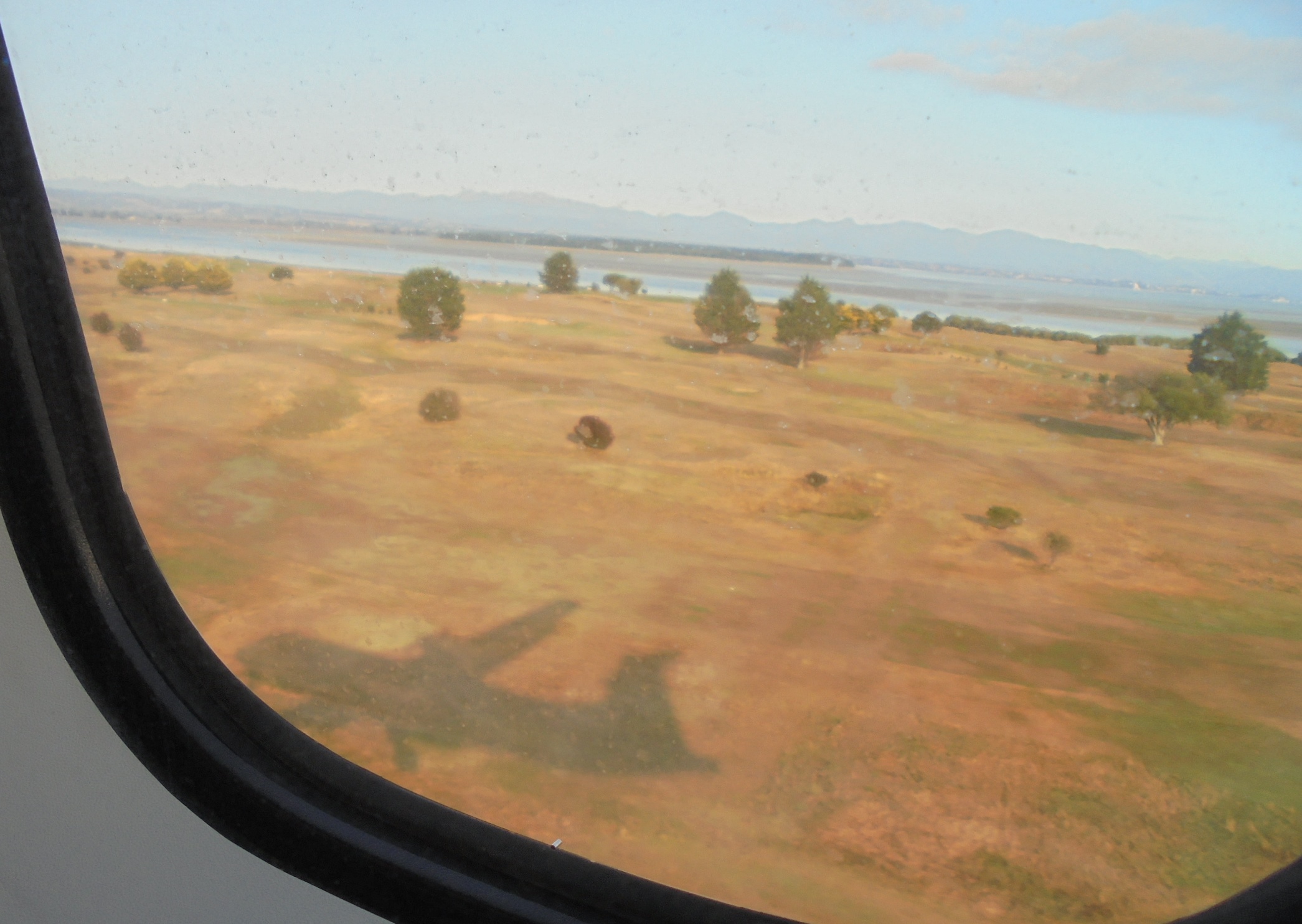
Once we landed we picked up our rental car and after exploring Nelson a bit we headed out. Here was our route:

We headed west and our first stop was in Ruby Bay where we met up with our friends Rene and Marianne.
After lunch we headed to Motueka where we spent two nights exploring the surrounding area.

The highlight of Motueka was the Sunday market. We’d been to a market in Nelson when we arrived the day before but it was one of those upscale community markets where they sell designer kids clothing and there are no free samples. The Motueka market was different. It was like I’d time travelled back to the 60s.
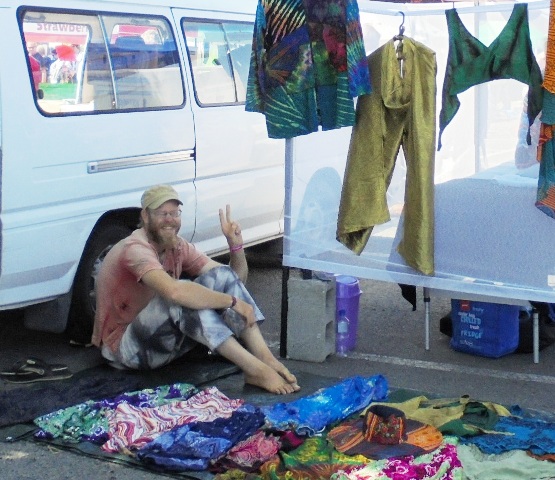
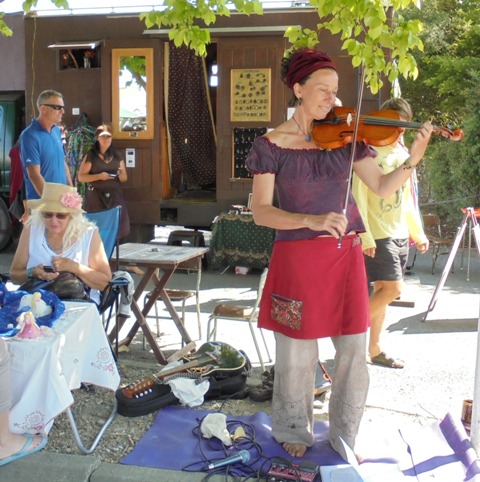

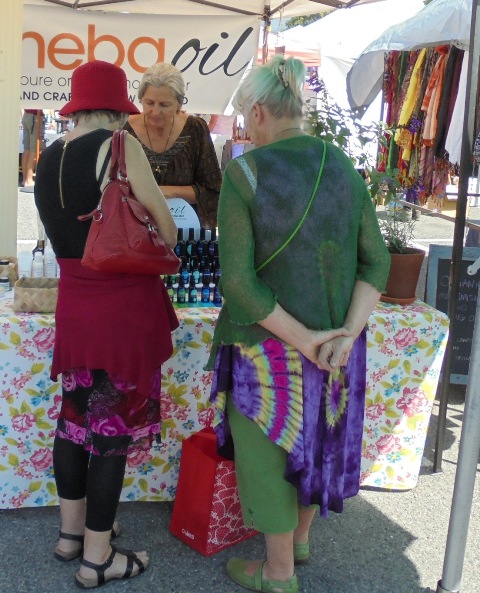


There was even a man who made guitars out of old car parts.
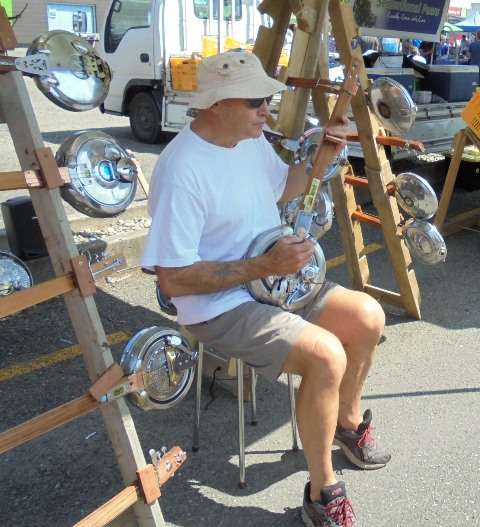
For the next few days we drove sort of in a loop to increasingly remote and beautiful places including Farewell Spit (the northernmost point of the South Island and at 27 km, the longest sandspit in NZ) and some of the very remote bays in Golden Bay and the Marlborough Sounds.
This area is also home to the Able Tasman National Park and the Kahurangi National Park and we did several short day treks exploring both parks.
I won’t describe each place, but this will give u an idea—around every curve there was another spectacular view or quiet beach. The beaches ranged from sandy (black, yellow or white sand), shelly or rocky. Here is a sample, in no particular order.

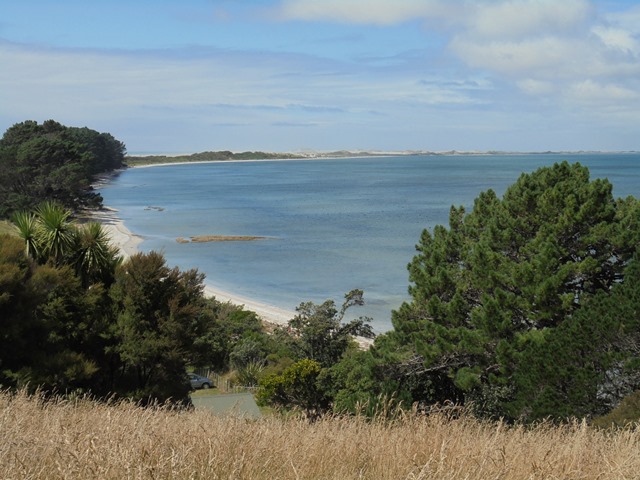
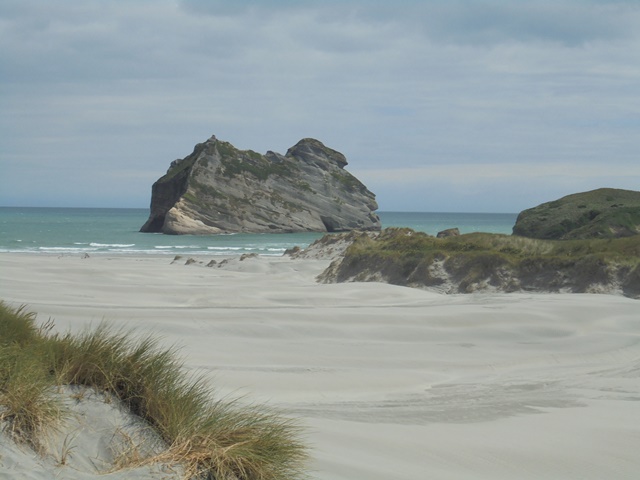
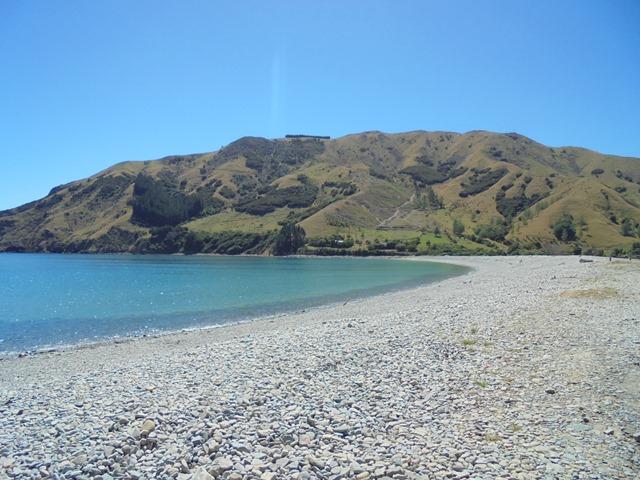
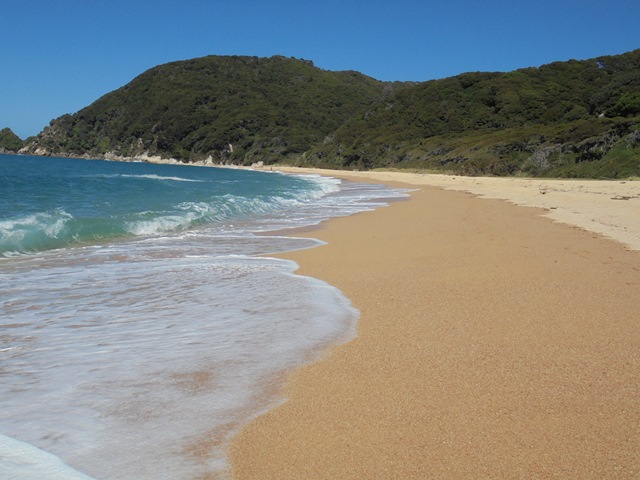

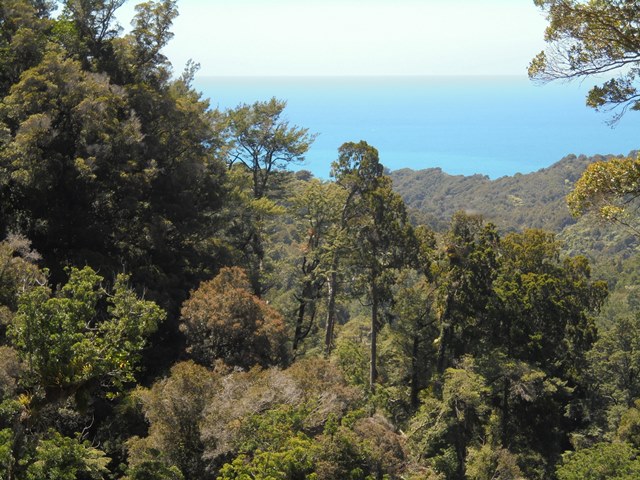


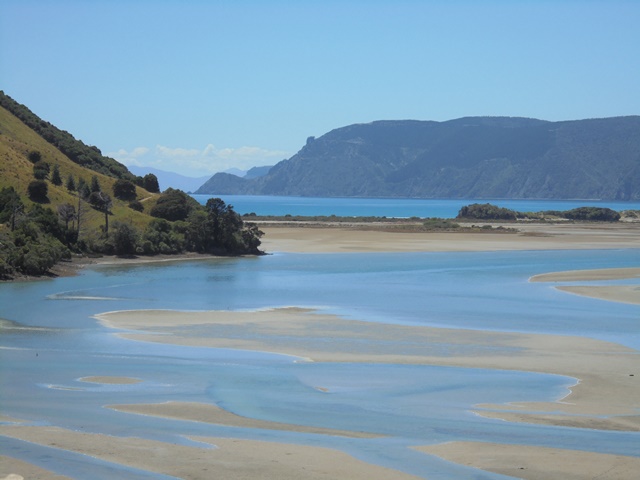


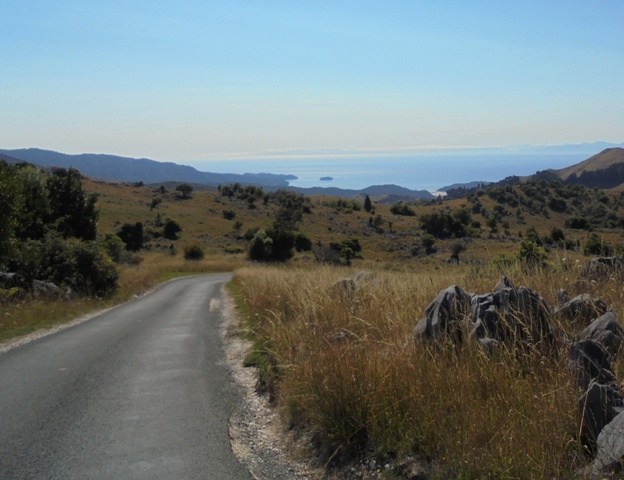
We drove on some interesting roads.
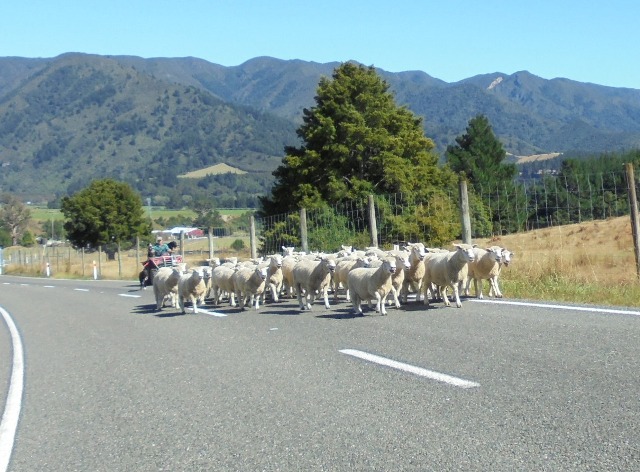

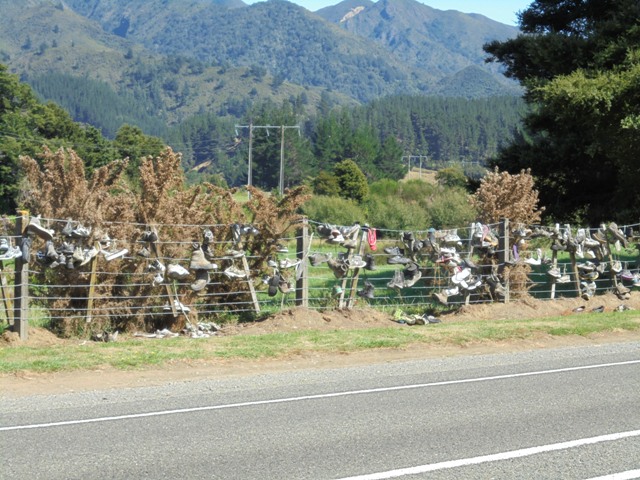
In the real world, old shoes hanging around can mean you’re in a bad neighbourhood. But not in this case. None of the locals knew how this got started but the shoes along this fence keep increasing in number!
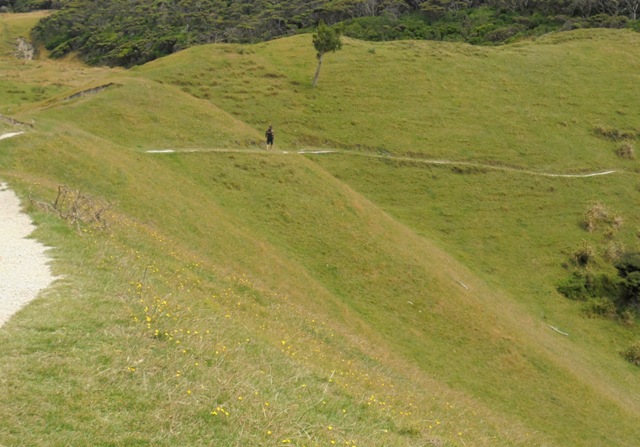
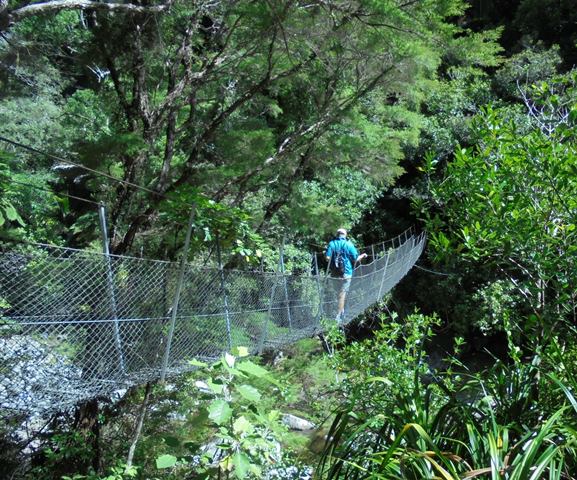
We walked on some scary paths.
Along the way we saw some interesting signs:


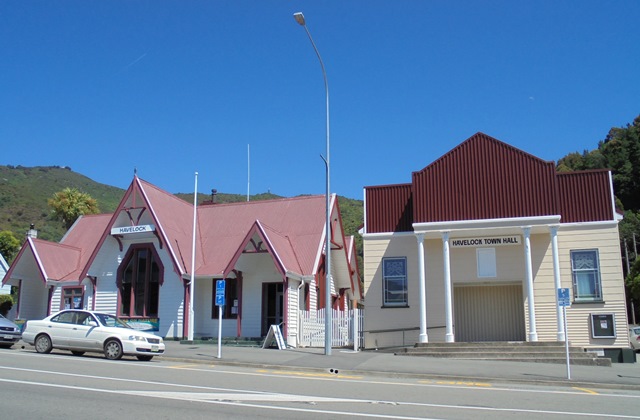
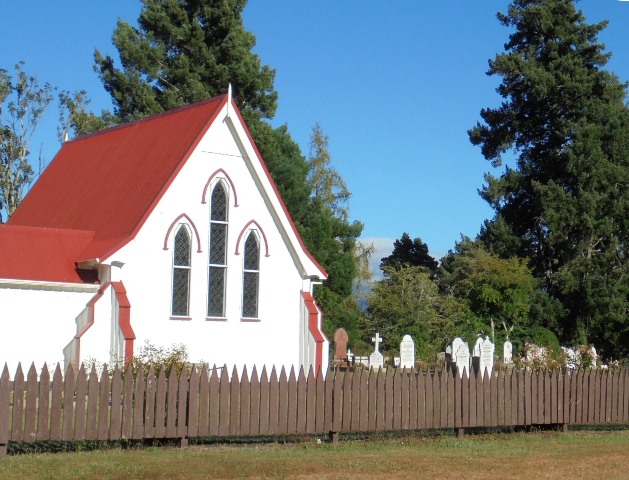
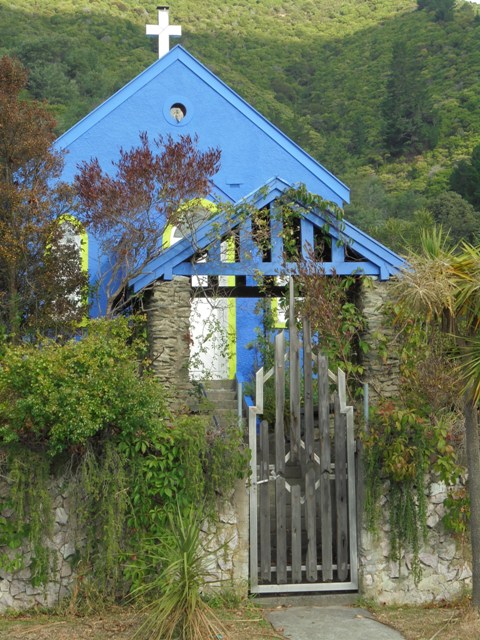
And visited some picturesque settlements.

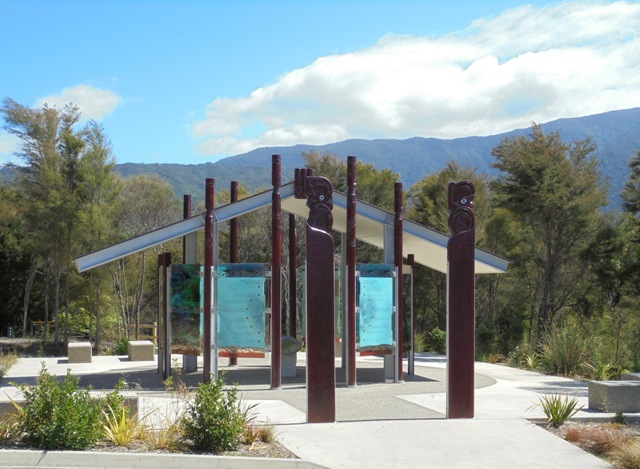
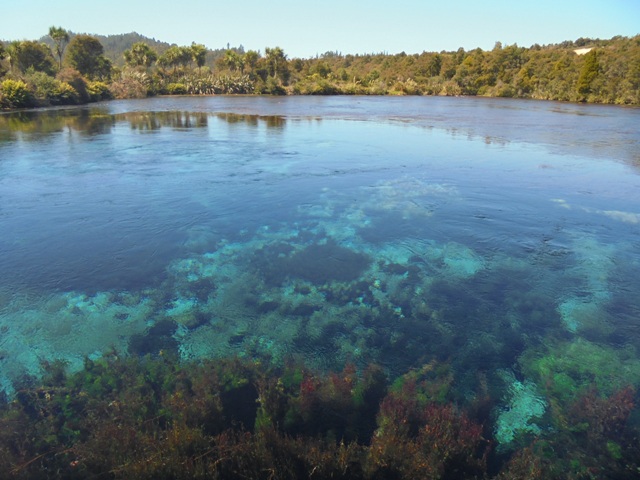
We also stopped by the Te Waikoropupu Springs, which are considered very sacred by the local Maori. The water is among the cleanest in the world with visibility up to 63 metres (207 feet).

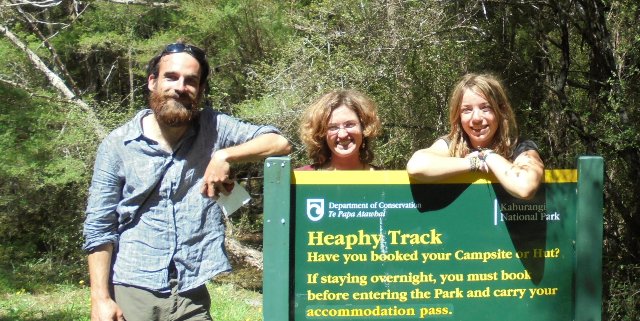
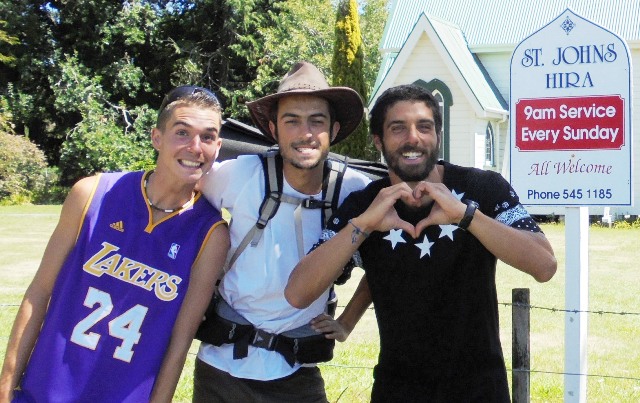
Hitchhiking is a good way to get around the South Island and we did our part to help out some young German and French visitors.
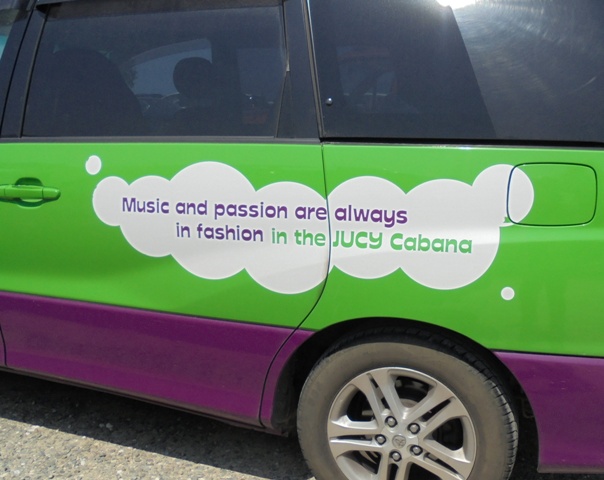
Many tourists opt to travel by camper vans or combi vans and some of the rental companies have interesting messages.



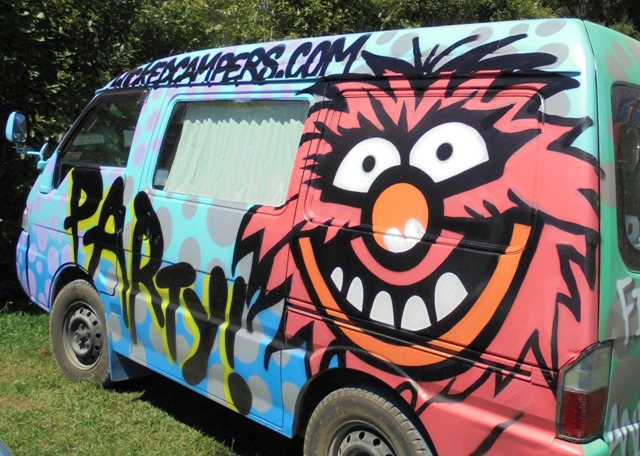
While some prefer to get to the secluded beaches via a ferry shuttle that has its own docking ramp.

But it wasn’t all fun and relaxation! Before we left for the trip I was doing some research and learned about something called the “Skywire” which was billed as the “longest flying fox in the world.” I’d never heard of a flying fox until I came to NZ. Basically, it’s a playground ride. A cable is strung between two uprights and a sort of wheel box with handles is attached to the cables. You run up, grab the handles, lift your feet and you sail along. The Skywire was right on our route and I figured, why not.
Unfortunately, I stopped reading their website before I came to the words “highest” and “fastest.”
We found the place and met Jill, the owner. She had me fill out a rather alarming release form and then told us that Scott would be our guide and take us up to the flying fox. We were the only visitors that afternoon so things were very relaxed. Scott took us on a long and entertaining drive around the property in a four wheel drive truck. In addition to the flying fox they have paintball and off road adventures on quad bikes and he gave us a nonstop explanation of everything we saw. At one point we got out of the truck because he wanted to show us some very mature approximately 1,800 year old native matai trees on the property. As we were getting back into the truck he pointed overhead and said, “Oh, by the way. You see those wires up there? That’s where you’re going to be in a few minutes.”
Suddenly it didn’t seem like such a good idea.
Of course it was too late to back out and we got up to the launching site. Four people actually sit in this flying fox at once and it is motorised. Scott made a ritual of starting everything up and explaining all the details, including fascinating topics like the frequency of lightning strikes.
He strapped me into my chair.

The white box behind him is a control box that includes a speedometer so you can see how fast you are going. It also has an intercom attached. The picture below shows Scott’s hand grabbing the microphone to clip it onto my shoulder harness.
He explained that in case of emergency we would be able to communicate. As he put it, “I won’t be able to do anything to help you, but at least you’ll have someone to talk to.” Actually it’s not so much for technical emergencies but he said that some people totally freak and the intercom is so that they can beg to have the ride aborted. He paid me a dubious compliment by looking at me and saying, “It’s usually the big macho guys who lose it.”

I was informed that a short distance beyond the tiny light patch straight ahead is where the other tower is located. On arriving there, the flying fox would reverse and return to base. Once I was strapped in, he waited what for what seemed like an agonisingly long time before launching me.
This is me receding into oblivion.

In spite of the wind and g-forces, I managed to take a few pictures. This is looking down:

And out to one side.

It’s really high–and this shows the dangers of not doing your research. The entire trip is a little over 3 kilometres (almost 2 miles) and at the highest point you are 150 metres (almost 500 feet) above the trees. Depending on the weight of the passengers, the Skywire can reach speeds of up to 115 kmph (about 70 mph). The heavier the weight, the faster the freefall and as I was the only passenger, my maximum speed according to the controls was 87 kmph.
The two worse parts are near the far end when you start to slow down. Of course you have no idea if that’s supposed to happen or if some horrible malfunction is occurring. Then there is the arrival at the far end where you come to a full stop and prepare to reverse. You are dangling above the treetops and although intellectually you know that something has to be done to the machinery to make it go backwards so you can return to earth, it seems like forever—at least long enough to convince you that the reverse switch isn’t working.
I was feeling pretty good on the return trip, especially when I slowed down for re-entry. I came to a stop, anticipating a slow cruise back to the gate. My buddy Scott, no doubt in collaboration with my wife, decided that since there was no one else around and since I hadn’t been screaming on the intercom to make it stop, decided I’d enjoy another trip. So I was off again.
The second time wasn’t as bad and I even had the presence of mind to switch the camera to video and film the adventure.
Seriously, it was a really fun ride and I’d highly recommend it.

Since I was still on the high flying buzz, we decided to visit the Omaka Aviation Heritage Centre. This museum has one of the world’s most extensive collections of both static and flyable World War I aircraft. Movie director, Peter Jackson (of the Lord of the Rings and Hobbit movies) is an avid enthusiast and many of the rare planes and memorabilia are from his private collection.
The museum has been designed by cinematic and special effects craftsmen and although it was well worth a visit it also makes you wonder why 100 years on, we have not learnt from history.


The Nelson-Golden Bay area is considered to be the artistic capital of NZ with a variety of artists in residence here. You can visit several of them at their home/art studios and watch them at work.
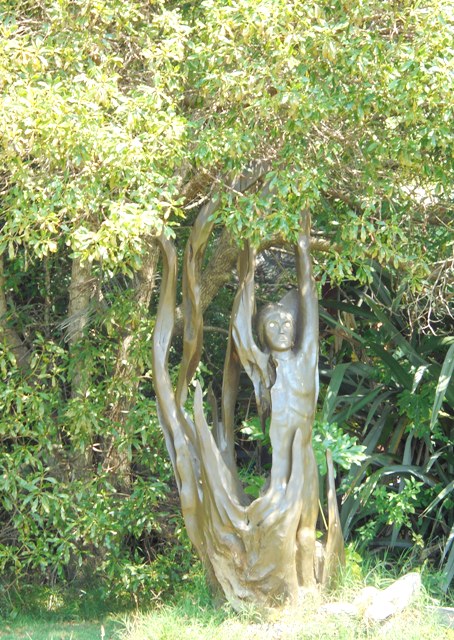
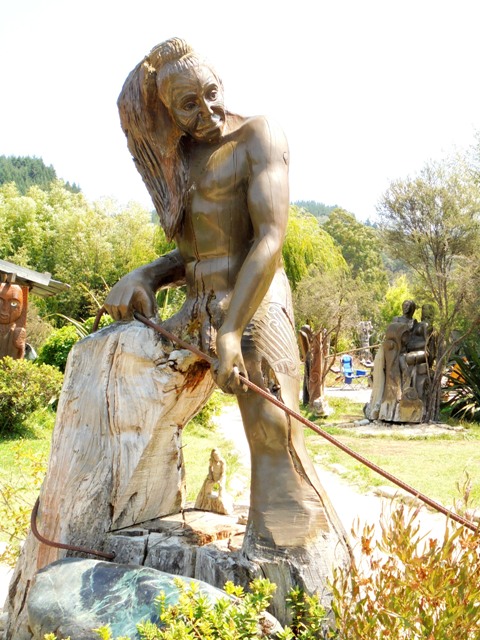
At Marahau, we visited an open air art gallery displaying sculptures by Maori wood carver, Woody Woodward. His beautiful works of art depict stories from Maori mythology carved on big logs of wood.
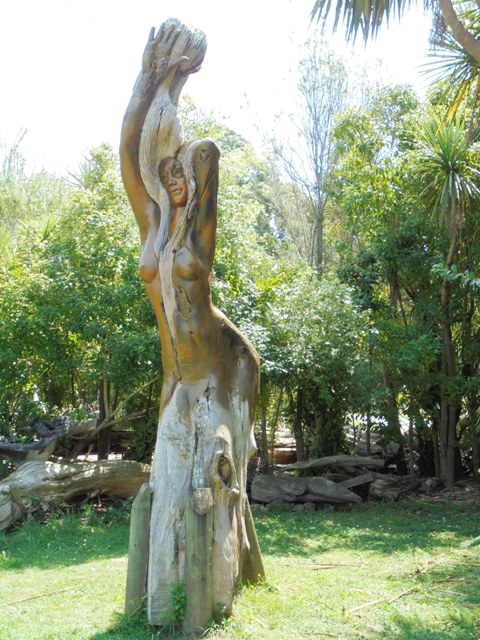
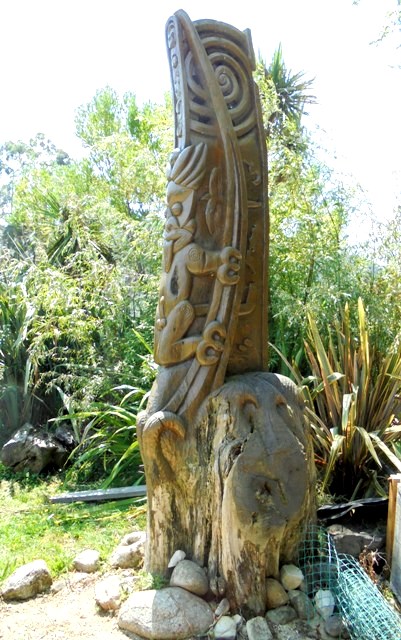

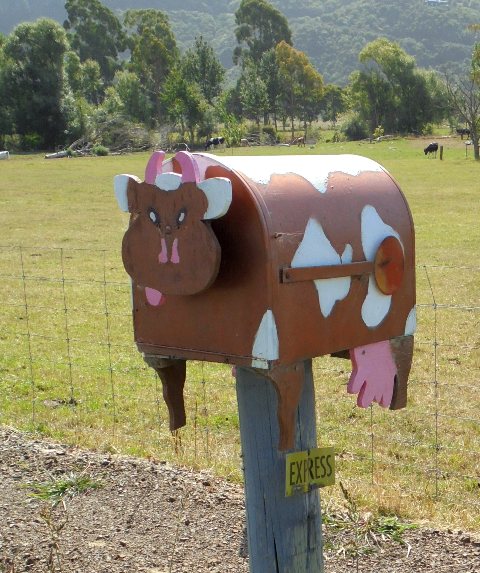
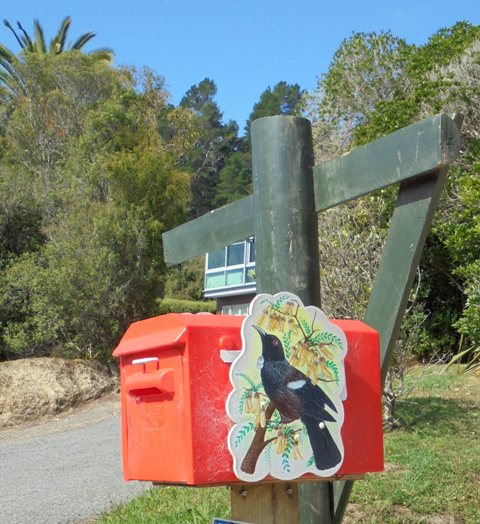
Not everyone has to be a professional artist to be creative. As we drove through a settlement in the Marlborough Sounds called The Grove we admired the residents’ interesting mail boxes.


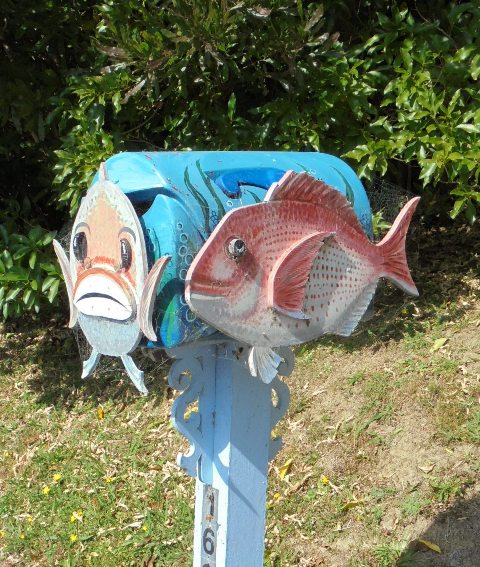
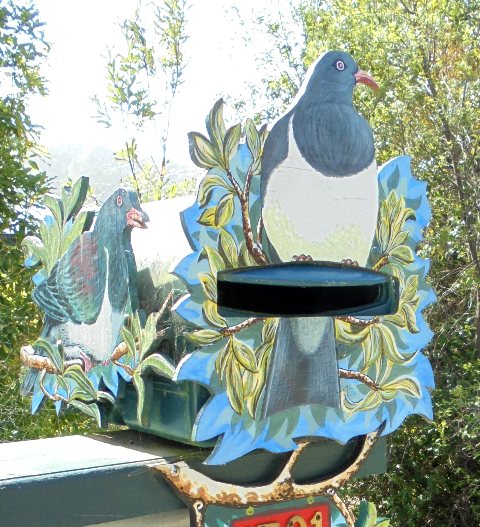


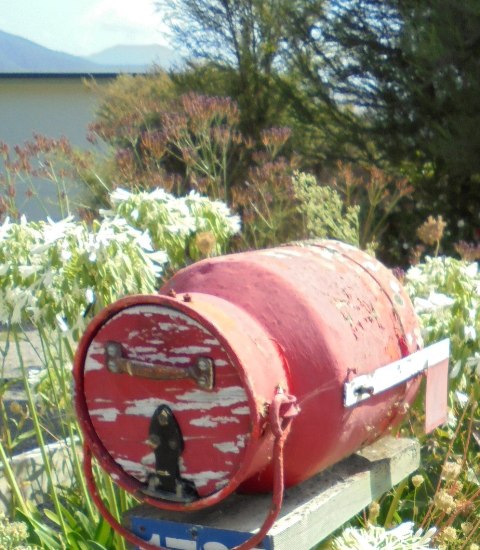

We headed back to Nelson for our flight back to Auckland and spent a couple of days exploring the Brook Waimarama Eco Sanctuary, gardens, beaches and museums in/around the city.
One of the highlights in Nelson was a visit to the World of Wearable Art and Classic Cars Museum.
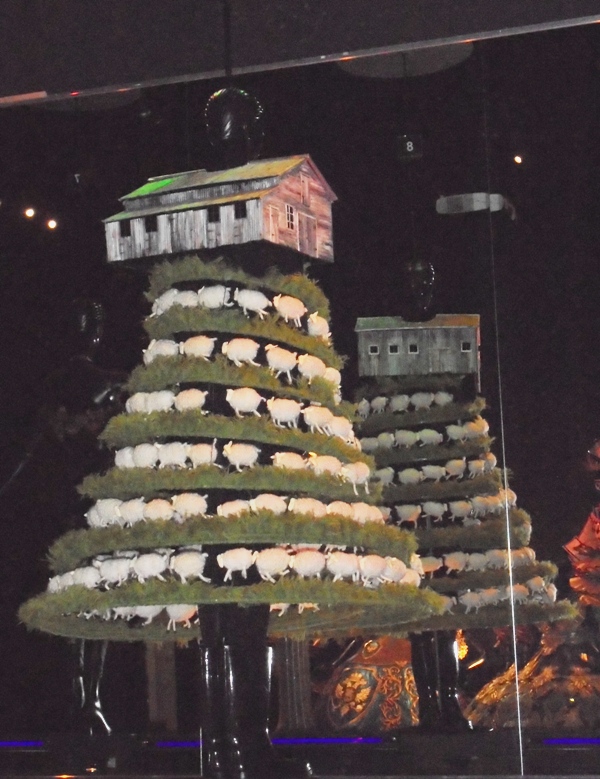
The Wearable Art competition started in Nelson in 1987 with artists creating, well, wearable art. The competition became so successful and generated so much interest that is has now moved to a bigger venue in Wellington and every September-October draws artists from all over the world. The museum in Nelson houses the winners of the previous year’s competition and the creativity is amazing. Here are a few samples—real models actual wear the garments during the competition.
This was the 2014 supreme award winner ‘Poly Nation” made of old suitcases and representing the journeys people make and the ‘seeds’ they carry to other lands.

This is a dress made of balloons.

Here is a very New Zealand entry:
These are entrants in the “Bizarre Brassiere” category:

Some of the garments look best in black light:
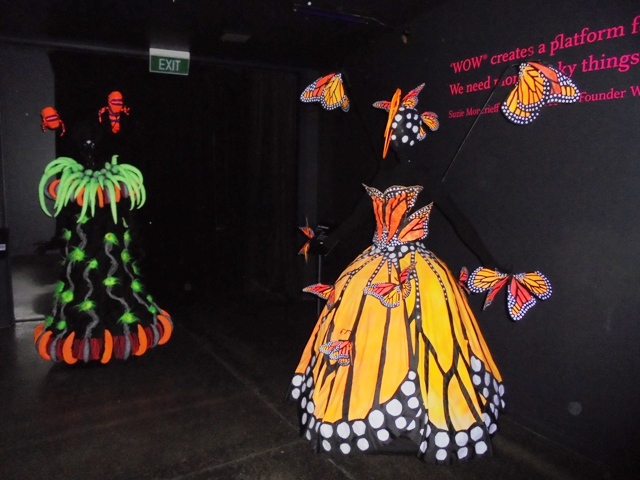
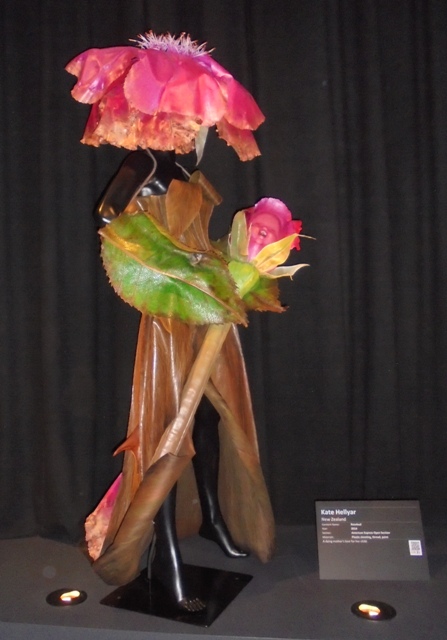
And here is one made out of eyeglasses:

And tea cosies:

And the private collection of 110 classic cars in the adjoining exhibition hall included some works of art, too.
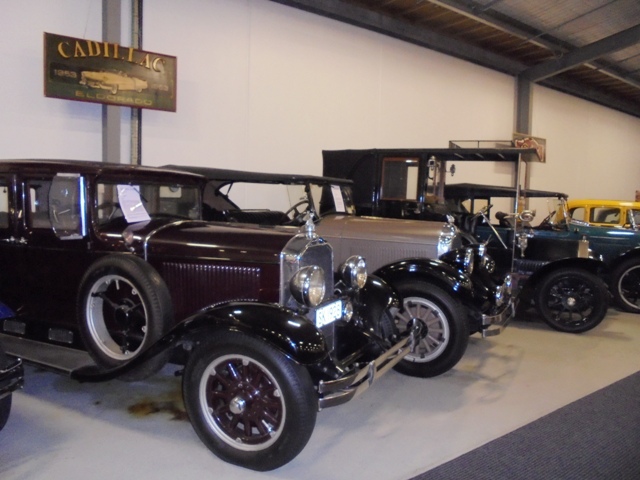
After all that culture, we decided to spend our last evening in Nelson fighting the crowd at the local beach.

A Quick Tour of the North Island
I’ve been pretty quiet since my last post in May, but a lot has been going on. For one thing, in June in an act of coordination and grace worthy of Baryshnikov, I had a fall at the farm and broke my leg. It sounds worse than it was and in retrospect was kind of a nice break. No pun intended. On second thought, yes, it was intended.
However there was hell to pay when I started walking again in October and had to catch up on all the things that had to be done on the farm. After a few hectic weeks and lots of willing volunteers, we got the place looking pretty good and even got some good publicity. If you want to see my rather inauspicious television debut you can have a look here.
We’d planned an overseas trip for August but because I couldn’t travel we didn’t do it. So we had a mini-vacation this past week with a trip down to Wellington to visit some friends. We decided to mix work with pleasure and stopped at a series of ecological restoration projects along the way to find out what other people are doing.
This was our route:

There are a lot of ecological restoration projects underway around New Zealand. The objective is to restore native forests and to create habitat for threatened NZ flora and fauna, especially birds.
Before humans came, there were no mammals except for a small bat. As a result, birds didn’t have to worry about predators and over time they lost the ability to fly. Many NZ native birds are flightless and even if they can fly, they often spend a lot of their time on the ground and some even build their nests on the ground.
When humans arrived with rats, cats, dogs, weasels and stoats, a lot of native birds’ days were numbered and today many of them are either extinct or seriously endangered. In addition to predators, other introduced pests such as rabbits and possums destroy the habitat of many birds by eating vegetation.
The local communities, with assistance from the local councils and the Department of Conservation have established several bird sanctuaries on offshore islands where it is reasonably practical to control predators, however over the past decade thanks to the initiative of several community groups around the country, a few mainland sanctuaries have been established too.
Several of the mainland sanctuaries are enclosed by predator proof fences. The fences are expensive to build and to maintain but they do a good job of protecting both native plants and animals. There are also open sanctuaries with no fences, like ours. We rely on predator control through trapping and poisoning but without a predator proof fence it is a challenge for a sanctuary to release some of the most endangered birds and animals. We visited three fenced sanctuaries and three open reserves.
The first place we visited was Rotokare Reserve near Eltham, Taranaki.

We arrived on Sunday afternoon and virtually had the place to ourselves. The entry is kind of scary because you have to go through two gates in the big fence. The 8.2 km long and 2 m high fence is even topped with an electric wire—very welcoming!

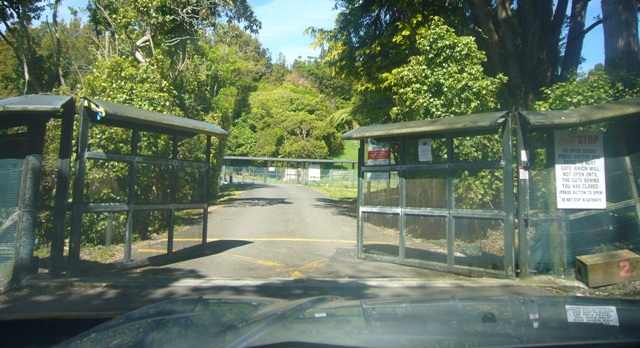
You press a button and drive through the first gate which then closes behind you. Only then can you press the button to open the second gate.

This reserve has a large lake in the middle which is open to the public for water sports. This has posed interesting challenges because the needs and expectations of the recreational water sporting enthusiasts and the environmentalists are not always consistent. But over time people have learnt to comprise and they are co-existing well.

We walked the 4 km track along the lake and saw some amazing mature native trees.
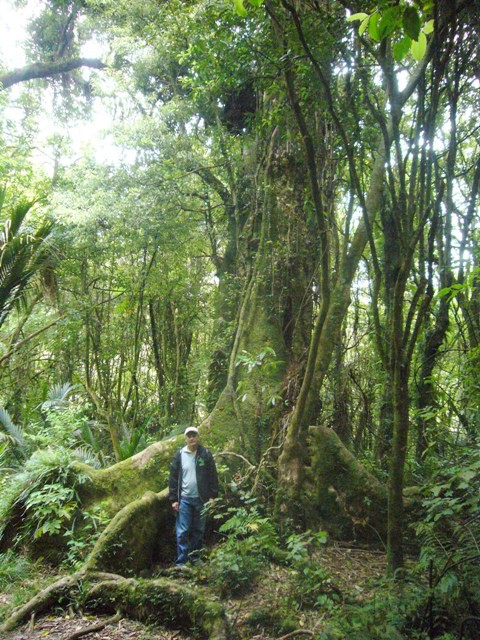

Bushy Park, which is near Whanganui on the way to Wellington, also has the same sort of double gate system.
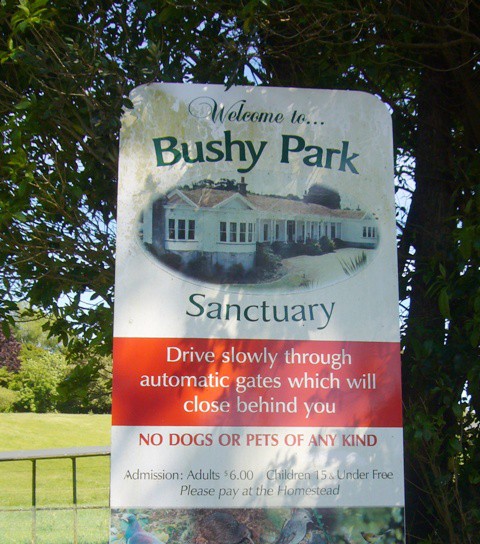
But it is unusual in that the stately home of the person who gifted the land to the trust is inside the sanctuary.

We saw the biggest and oldest known rata tree in NZ – estimated to be about 800 hundred years old with a height of 42 metres (142 ft) and a girth of 11.9 metres. A Rata starts life by germinating in the branches of a host tree. It then grows downwards and eventually completely surrounds and kills the host. As a result, rata trees are almost always hollow.
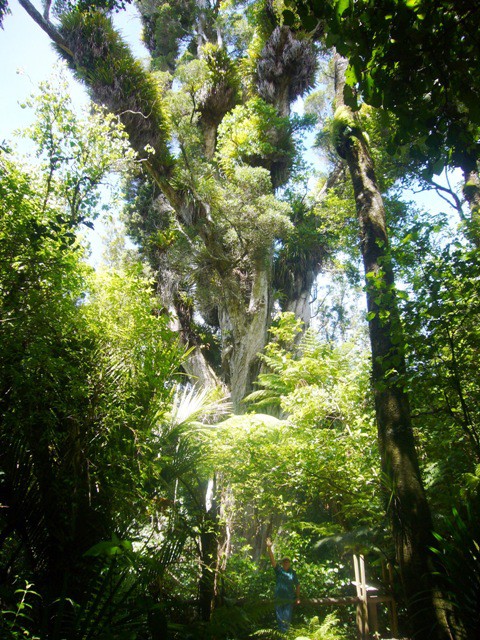
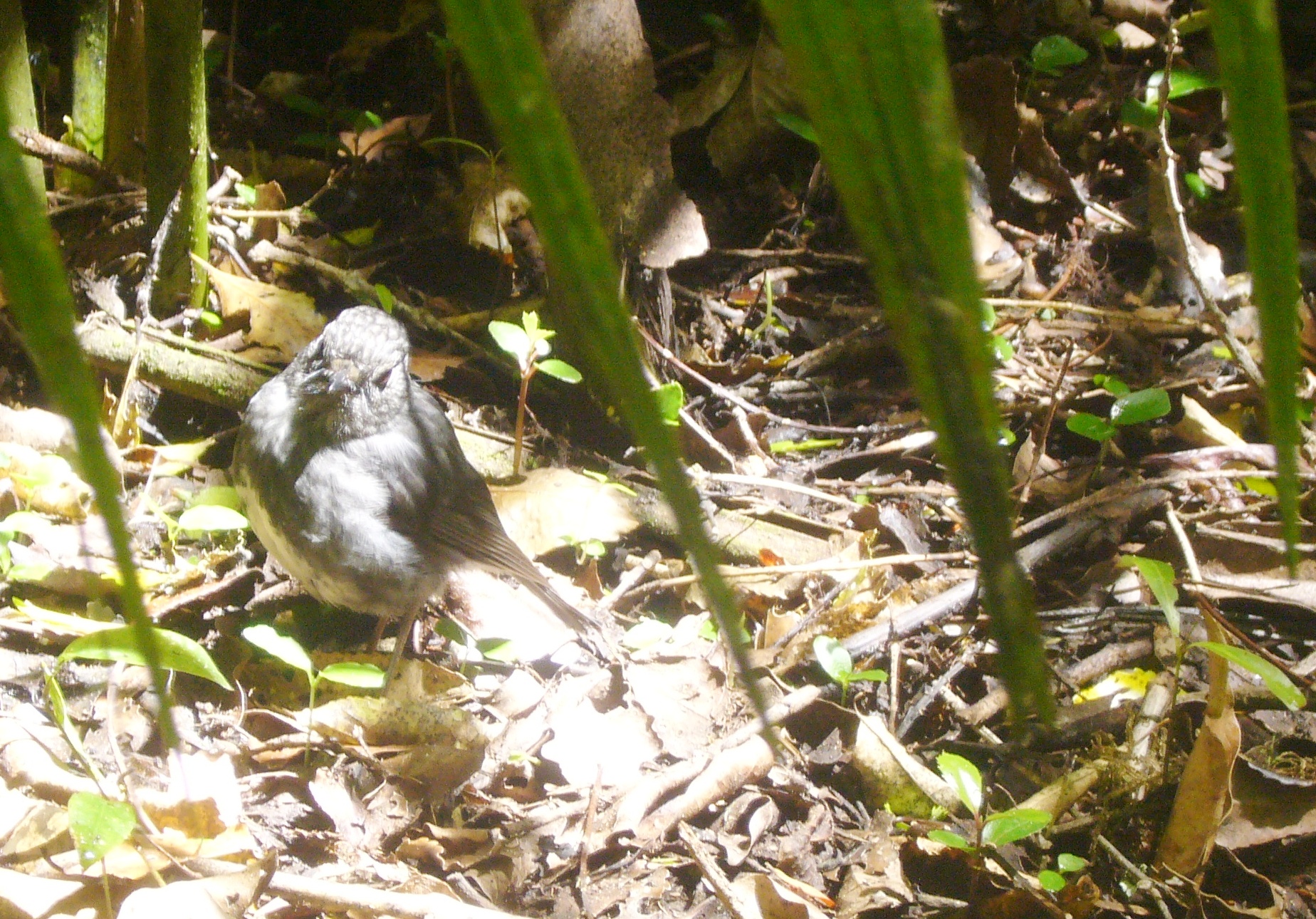
The walk was very peaceful and we saw many threatened native birds like saddlebacks and stitch birds that have been released in the sanctuary. Plus a friendly New Zealand robin followed us around for a while.
The last fenced sanctuary we visited is Maungatautari near Cambridge. It is the largest fenced sanctuary in NZ encompassing 3400 hectares (8400 acres).
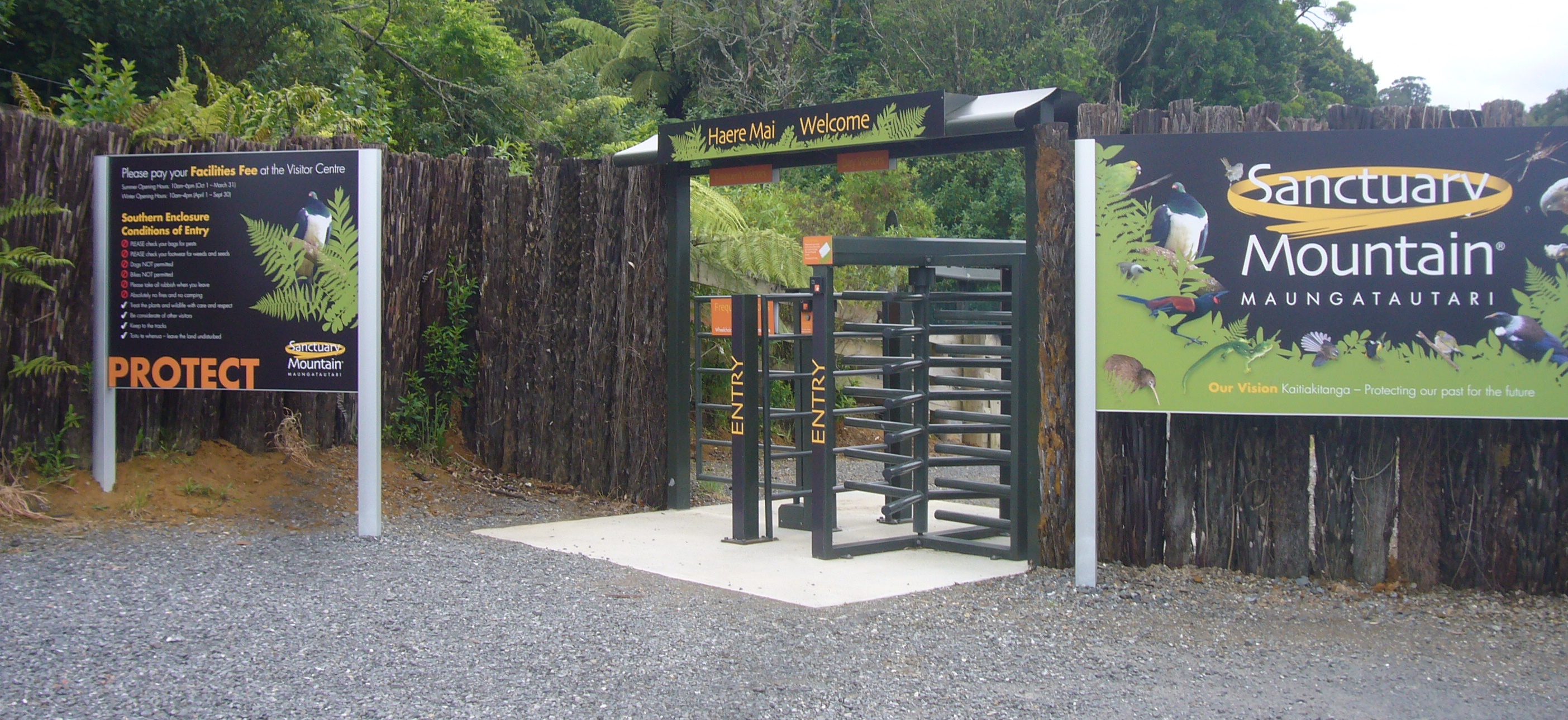
This sanctuary is another good example of how communities with competing interests can come together for the common good. Several neighbouring farmers and local Maori have generously given their land for the creation of this sanctuary.
It is on the top of an extinct volcano and surrounded by a 47 km (28 mile) fence.
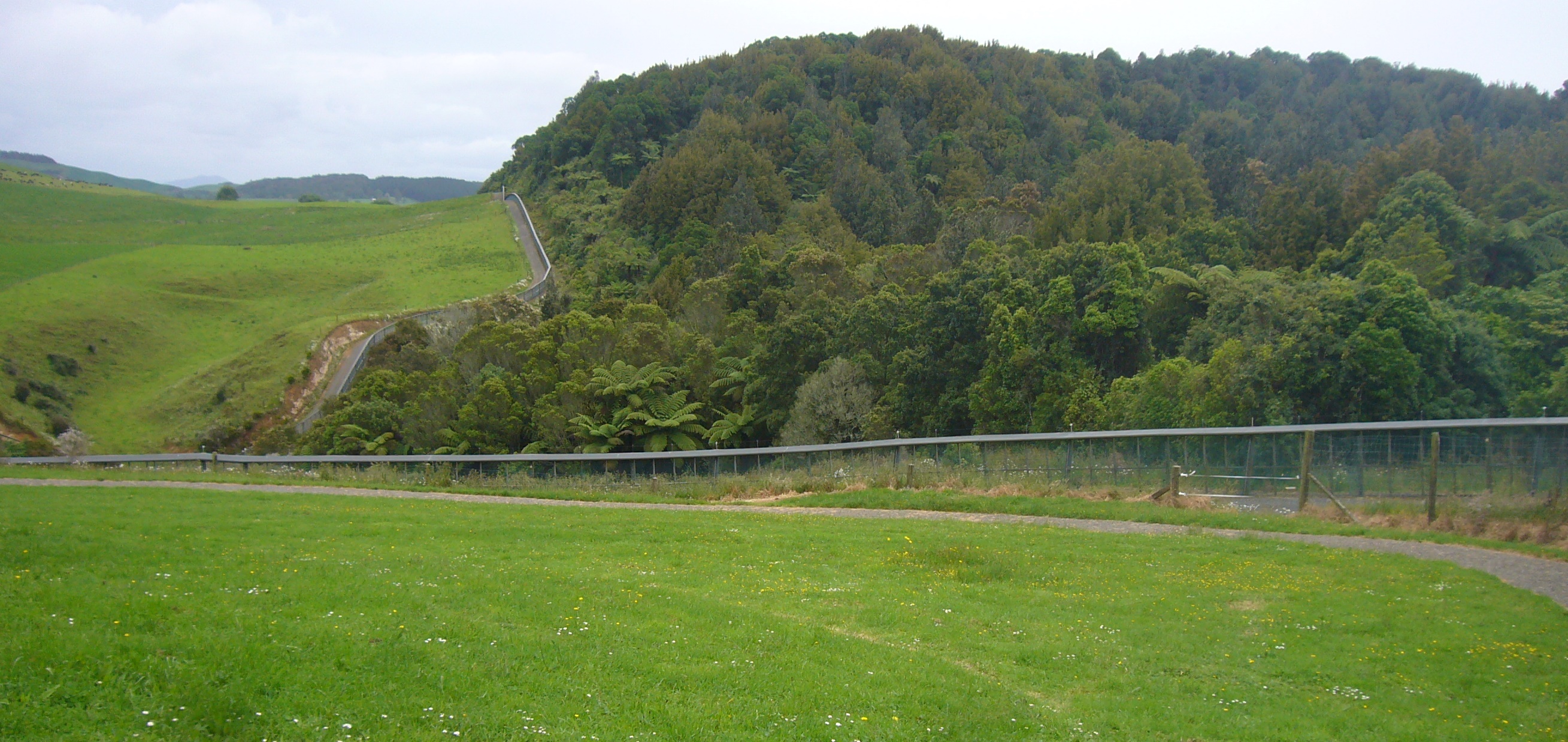
We spent a few nice hours walking around the various tracks within the sanctuary and encountered lots of birds. This is a kaka, one of NZ’s native parrots who can be friendly to the point of appearing aggressive.

In addition to the fenced sanctuaries, we also visited three open nature reserves, Nga Manu in Waikanae, Paengaroa near Whanganui and Otari Wilton in Wellington. Nature reserves without fences have a completely different feel.
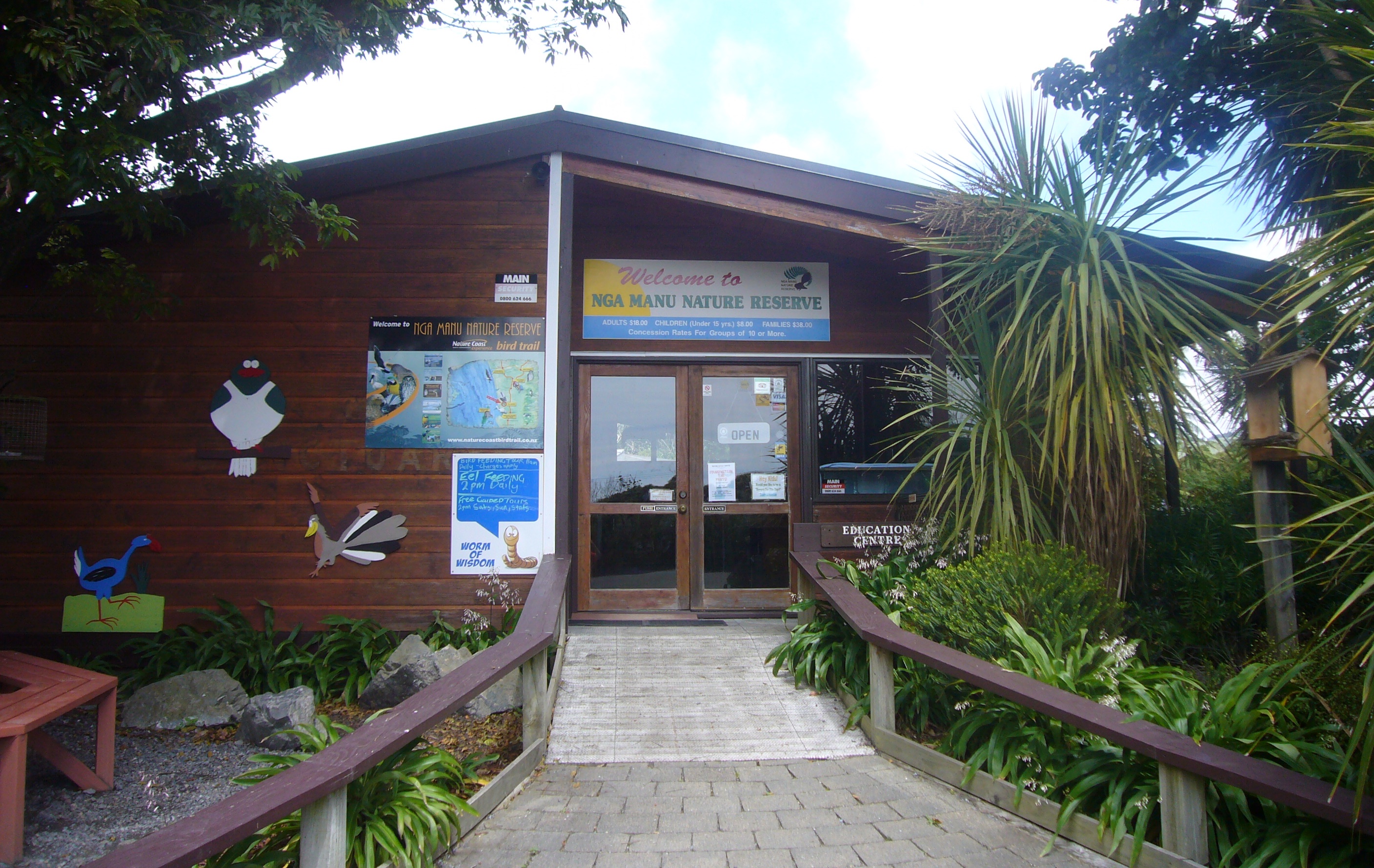

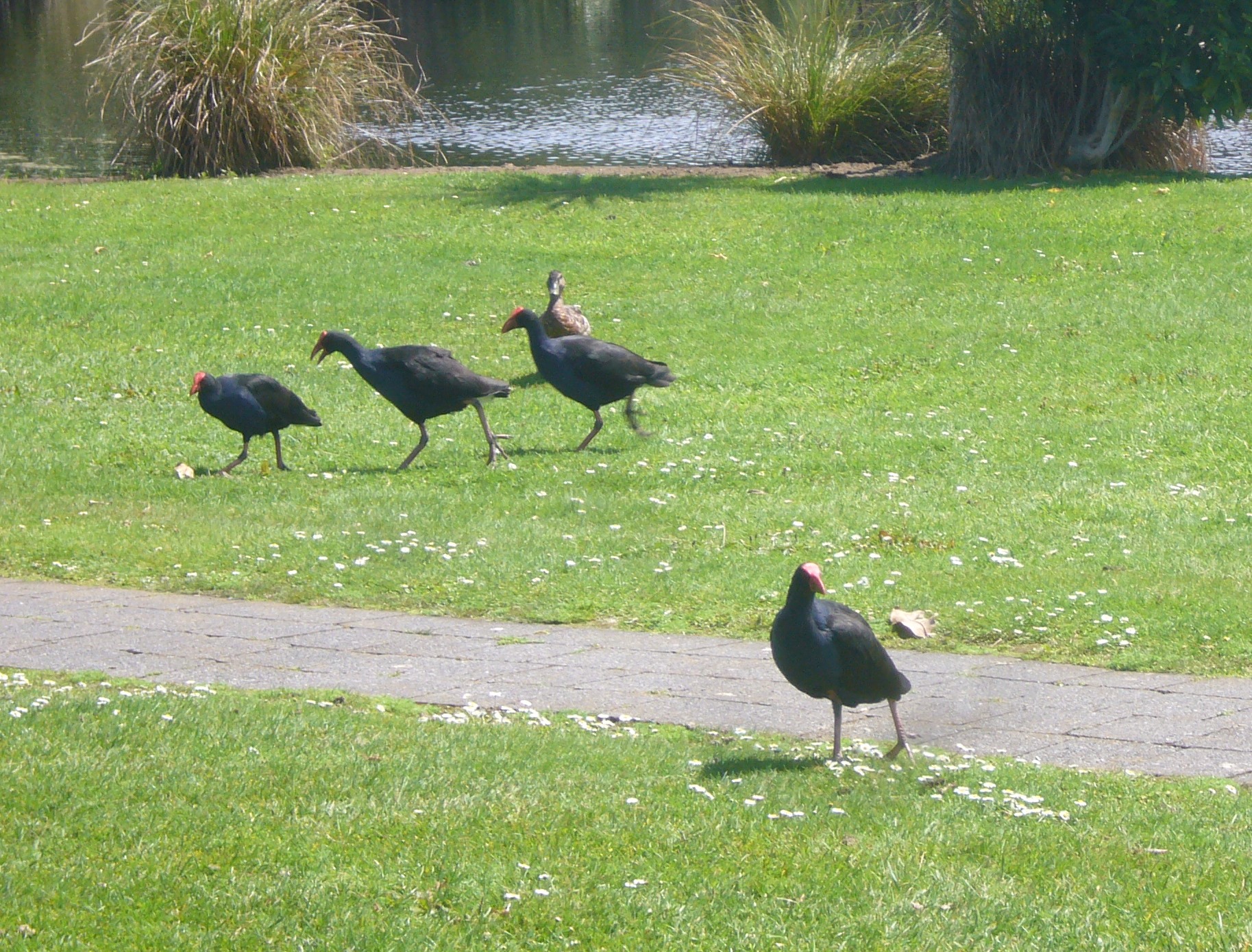
The only warning was to watch out for pukeko, a very interesting bird.
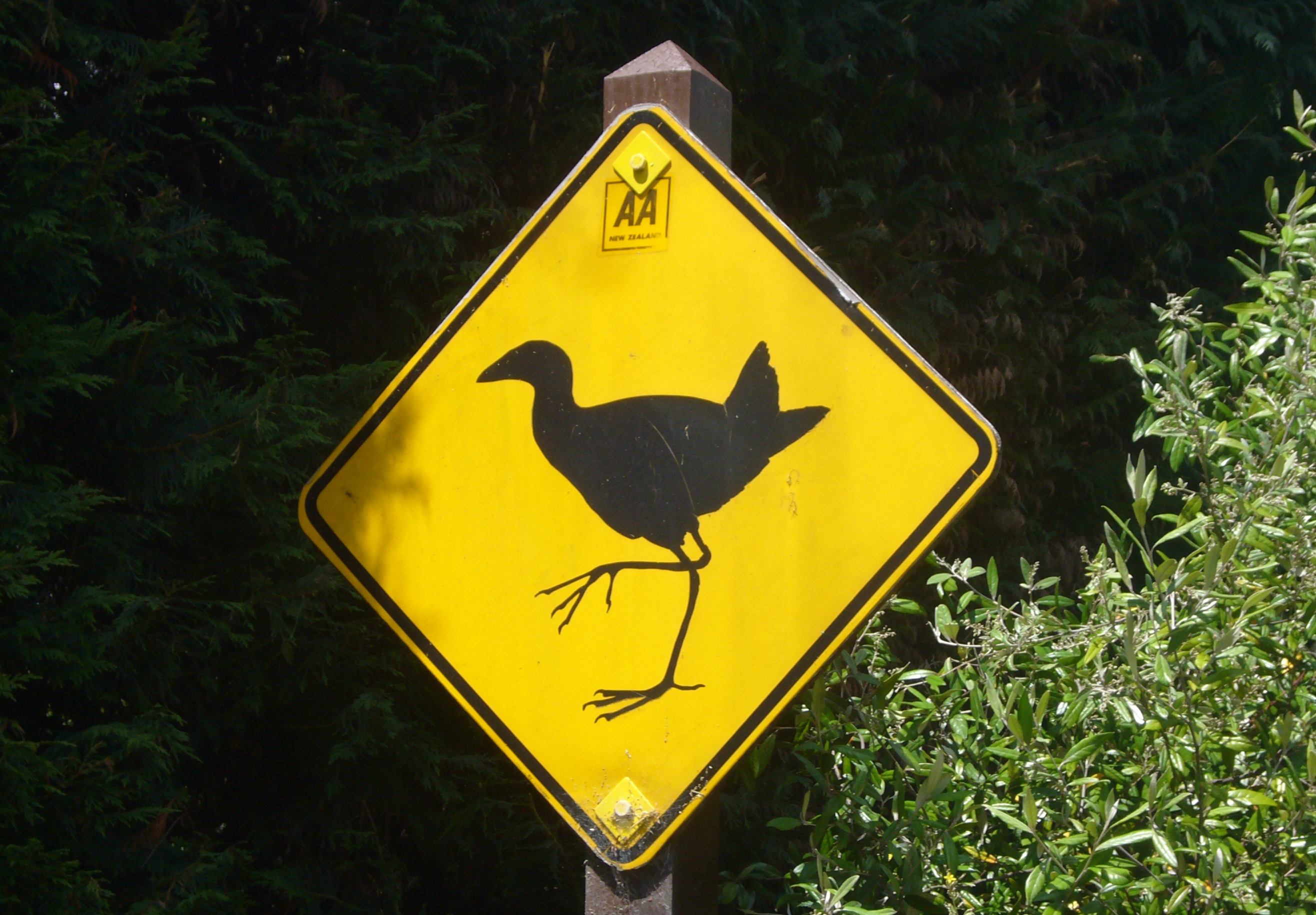
These are pukekos:
Actually there was another warning sign– that this bridge in Paengaroa could only take one person at a time. It actually felt like one was too many!

Although we spent a lot of time in the reserves, most of our time was spent enjoying the sights and people we encountered along the way. Rotokare is in Taranaki and the region gets its name from Mount Taranaki, a volcano. You may have noticed that I didn’t say “extinct volcano.” It is referred to as “active but quiescent” and the fact that they think it will wake up some time in the next 50 years doesn’t make me very quiescent.
The mountain is 2,500 metres (8,300 feet) high and dominates the landscape of Taranaki.

We spent the night in Hawerea and this was the view from our room.
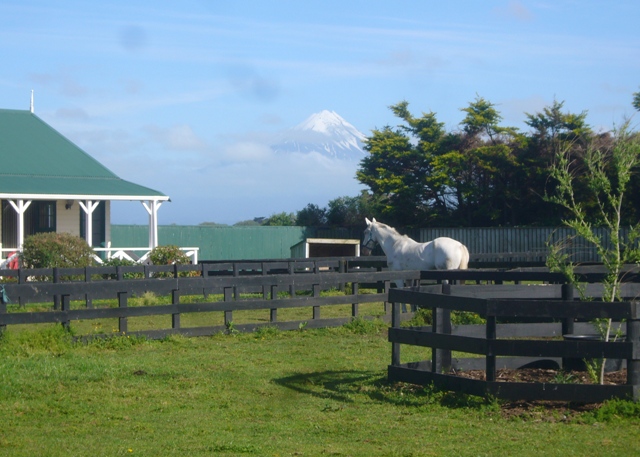
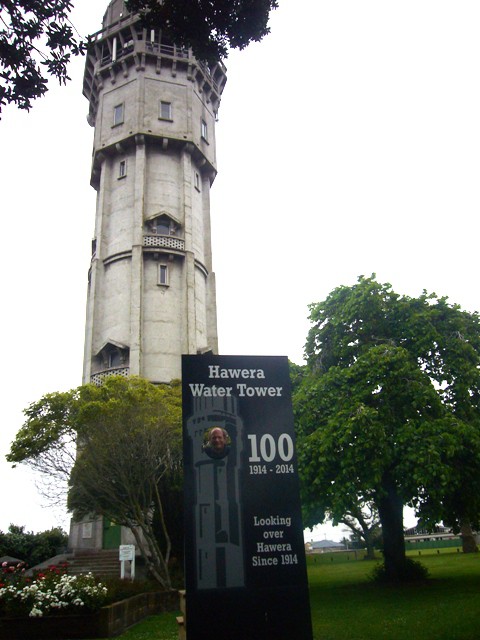
A bit of trivia. Hawera means “burnt place” in Maori because during a tribal battle a village was burned down. Coincidentally, over the years, the town of Hawera has had three huge fires and as a result a big (and fancy) water tower was built to ensure that there would be enough water to fight any future fires.
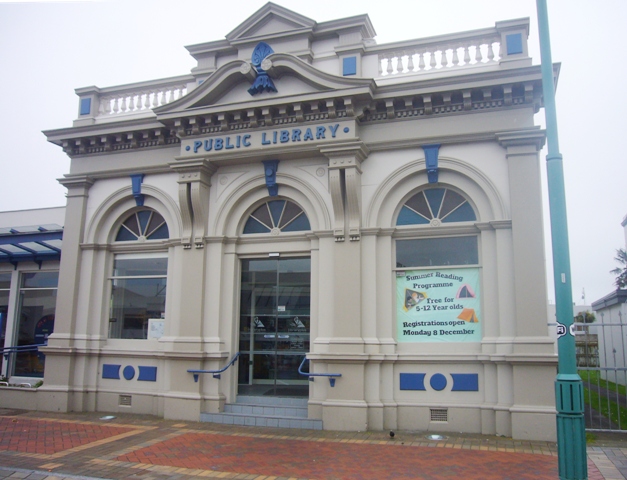
And this is the local library.
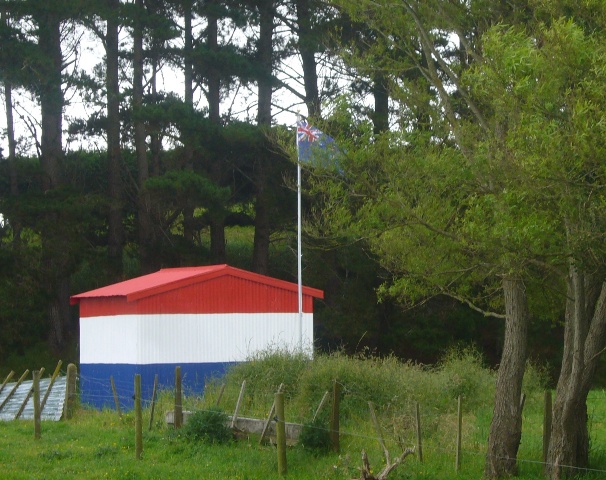
On the drive we saw a lot of interesting sights. Like this patriotic barn.
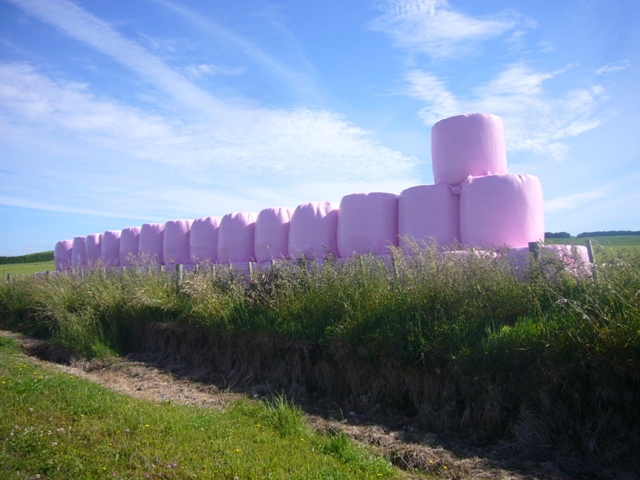
This is hay-making season and a lot of farmers have hay in plastic covered bales waiting to be sold or stored.

But in some areas they had pink plastic for breast cancer awareness—a new program started in the past couple of months to raise health awareness in rural areas.
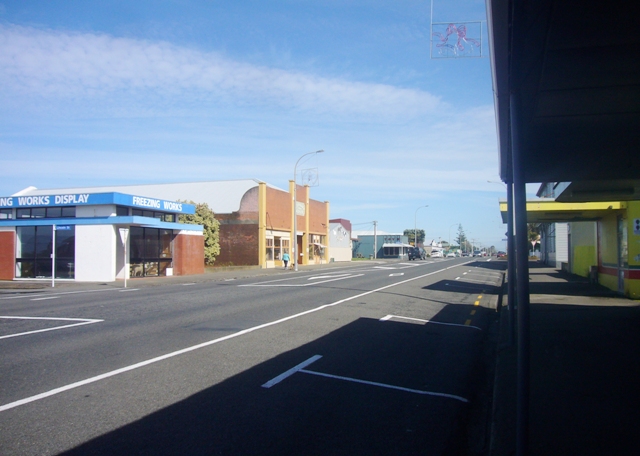
Most of the towns in Taranaki are booming because of the dairy industry but this one seemed a bit too quiet on a Monday morning!
We continued on our way to Wellington.
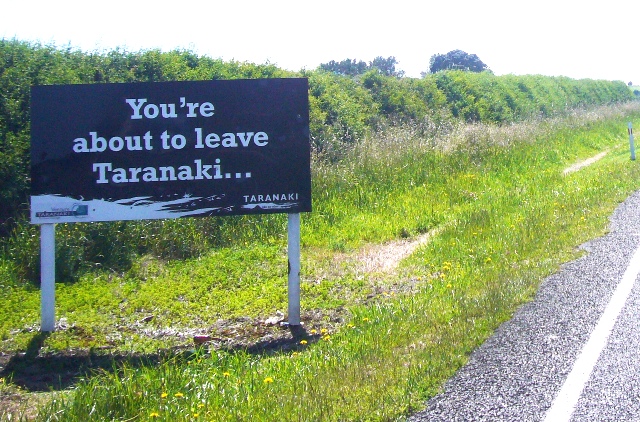

We encountered a lot of entertaining road signs along the way. Here is the sign announcing that you’ve arrived in Bulls, a prosperous farming town of 1,700.

We spent a few relaxing days in Wellington with our friends Pauline and Steve. On the way back we drove for a while along the Kapiti Coast which is the southwestern coast of the North Island. It is lined with small communities and black sandy beaches and we braved the crowds at Pekapeka Beach.

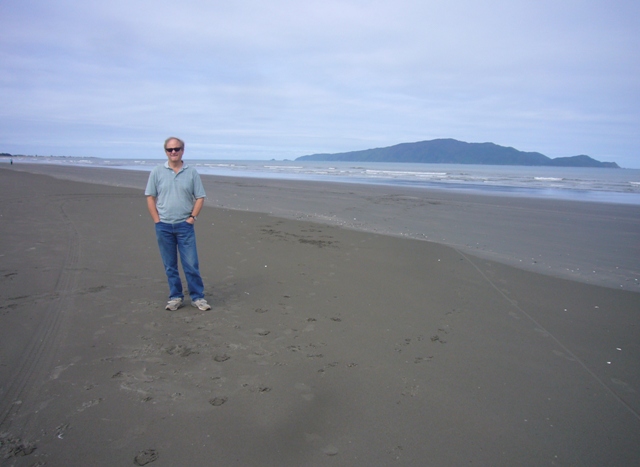
Behind me in the photo above is Kapiti Island which is an island eco-sanctuary.
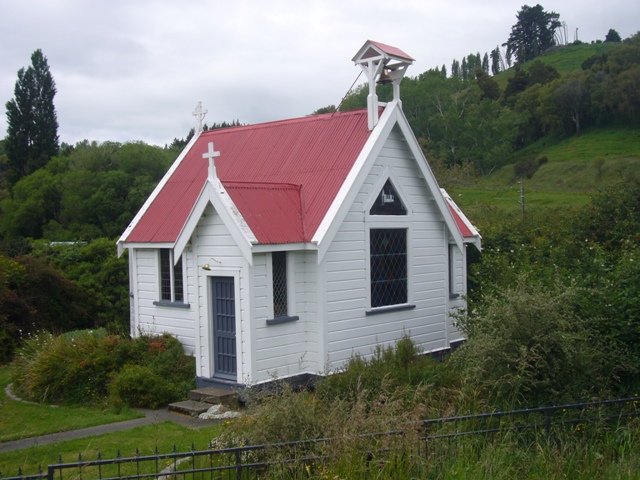
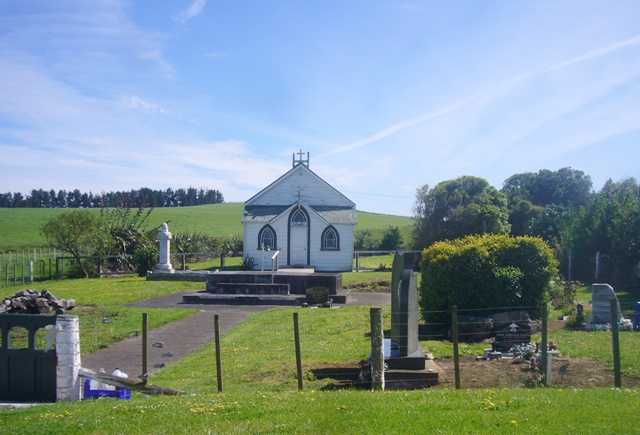
We were heading north towards Lake Taupo, which is a big lake virtually in the centre of the North Island. On the way we passed some picturesque old settlements.
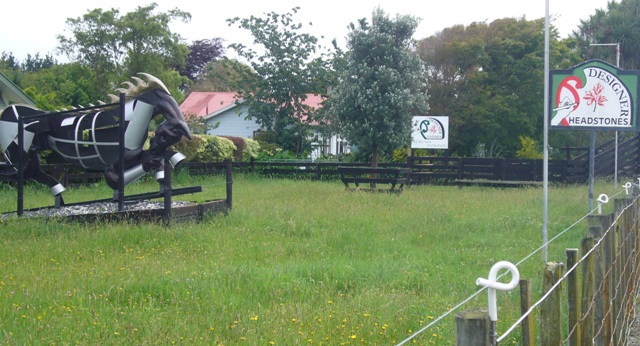
This interesting horse caught our eye.

But then we saw the sign.
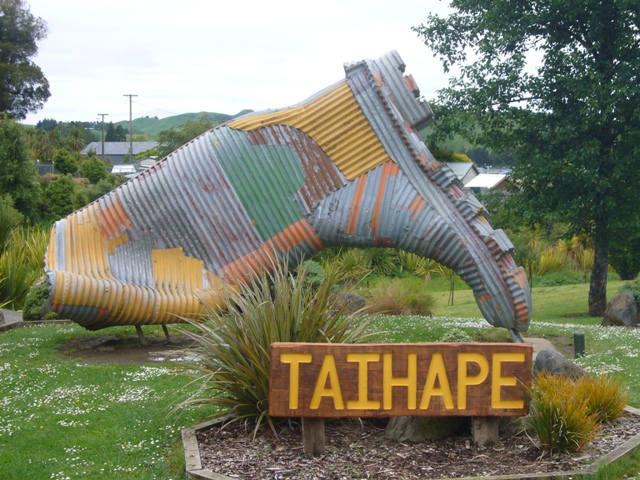
We passed through Taihape (pronounced Tie happy), population 2,000, which calls itself the Gumboot Capital of the World and welcomes you with a giant gumboot statue.
And here is the Taihape town hall.
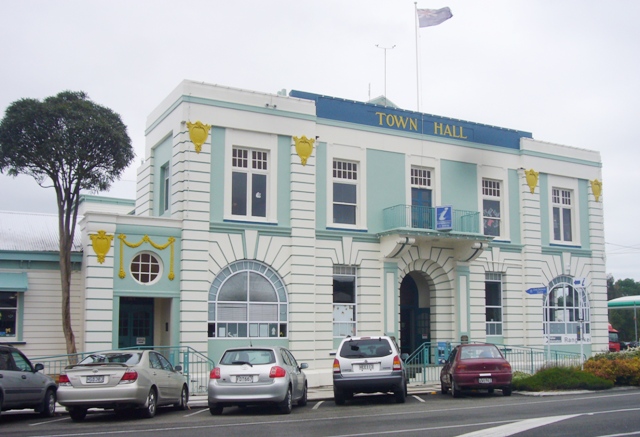
I was curious about the town name and found that it was originally Otaihape and that in Maori it means “home of Tai the hunchback.”
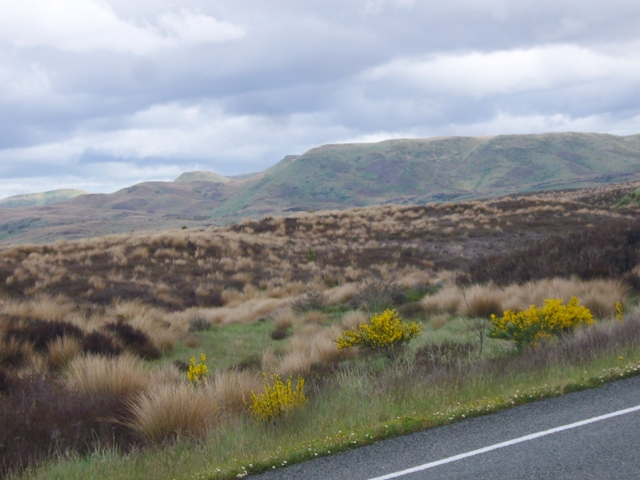
Lake Taupo is located on a high plateau and as we approached, the landscape changed from farms and forests to tussock.

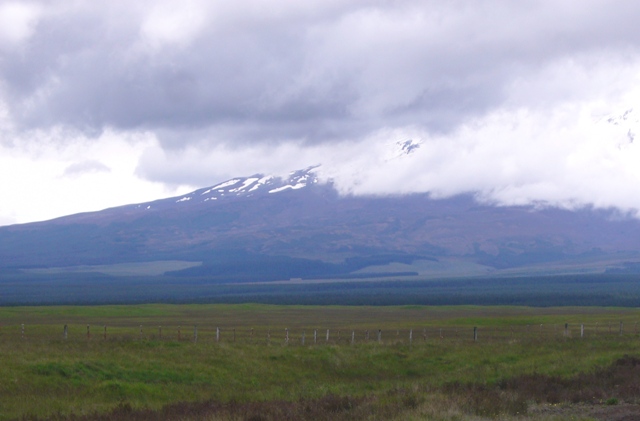
This part of the North Island is very geologically active and we passed Tongariro National Park which is home to three active volcanos—Ruapehu, Tongariro and Ngaruhoe. This is Ruapehu which last erupted in 2007, badly injuring a climber.
Lake Taupo is actually the caldera crater of a monstrous volcano that erupted about 27,000 years ago. It was supposedly the largest volcanic eruption in history and it has affected the geology of the entire country, covering the soil with several feet of volcanic ash and changing the course of rivers. The lake is 616 square kilometres (238 square miles) and is the size that Singapore was before they started making Singapore bigger by reclaiming land.
Today Lake Taupo is one of NZ’s most popular recreation areas with skiing in the mountains and fishing in the lake. You can tell by the little towns along the way that you are getting close to the lake and a recreation area.

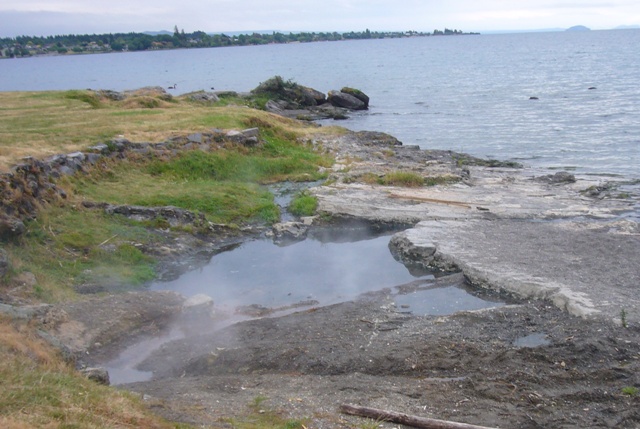
The lake is clean and beautiful and peaceful.

But it’s a little disconcerting because as you walk along the edge you will see little bare areas with steam escaping as the lake is fed by underground hot water springs. It’s hard to see the steam in the picture but I stuck my hand in the water and believe me, you don’t want to keep it there long, and you can see the mineral deposits that have formed as well. The water gets colder further away from the lake edges and in the centre the lake is 186 metres (600 feet) deep.
The lake is ringed with both vacation and permanent homes, from the very basic:

To the more opulent:

We had a nice walk around the lake and met some interesting natives and visitors. We came across a guy hitting golf balls into the lake and stopped to find out what he was up to.
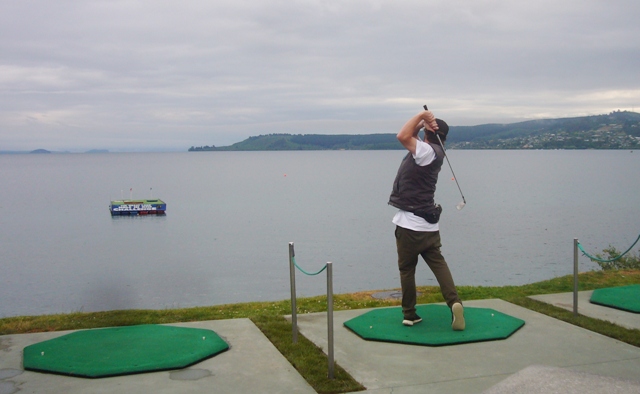
He was running the Lake Taupo Hole in One project. On the platform in the lake are three holes with the smallest being a regulation sized golf hole. If you get a hole in one you win $10,000 and there are lesser prizes for getting the ball in the larger holes or even for getting the ball on the platform. Divers go out to retrieve the balls. And the occasional club.
They charge $1 for one ball and you can also buy buckets of 18 or more balls. I figured I’d give it a try for a buck. The guy took one look at me at me and very kindly handed me two balls in exchange for my dollar.
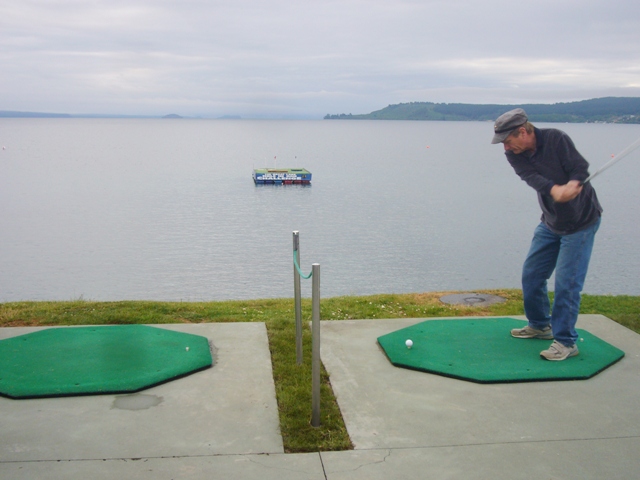
How did I do? Suffice it to say that this picture doesn’t include the landing zones of my two efforts. However, the guy did tell us that over the last 7 years 19 people have won the $10,000 prize!
We spent the night at Lake Taupo and then headed north towards our last stop before Auckland.
A must see attraction just on the outskirts of Lake Taupo is Huka Falls. It is a gorge where the Waikato River, New Zealand’s longest river leaves the lake and starts its flow. Because a huge amount of water is trying to get through a small area there is a lot of activity and a beautiful waterfall.
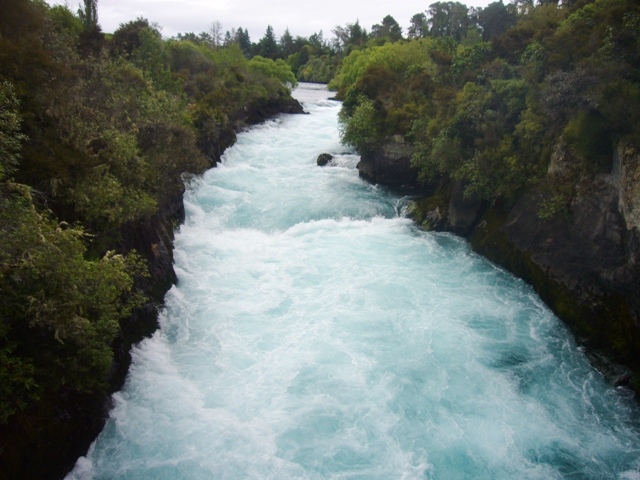
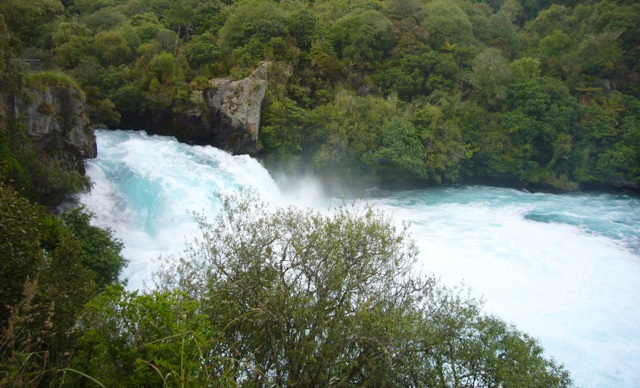
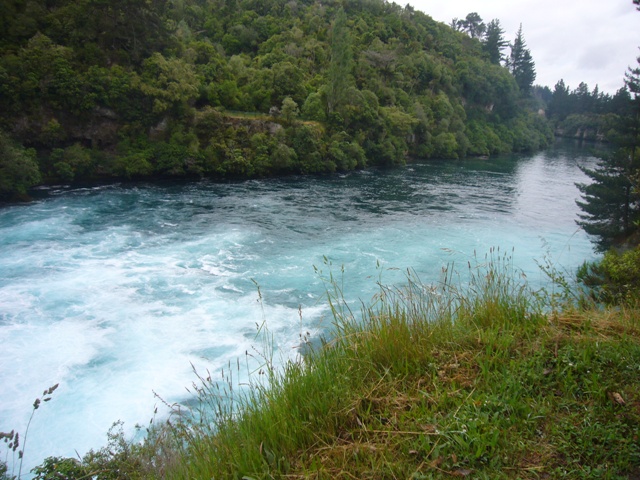
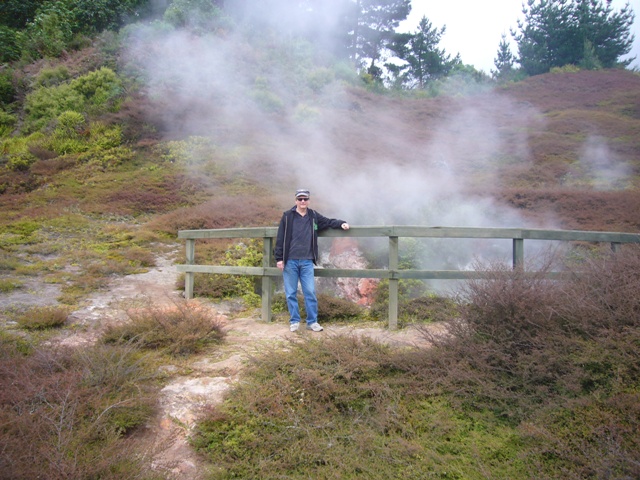
Because of all the volcanic activity in the area there are a number of geothermal attractions. Our next stop was a place called Craters of the Moon. It is a big area with several vents leaking steam. There is a sulphur smell in the air and the chemicals coming up with the fumes have stained the surrounding soil and prevent anything but scrub vegetation from growing.
It’s real steam coming out of the ground and the holes are very deep so they don’t fool around:

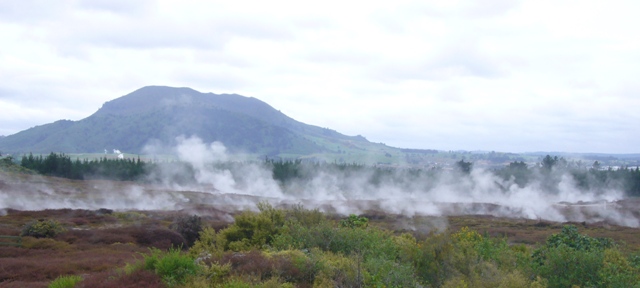
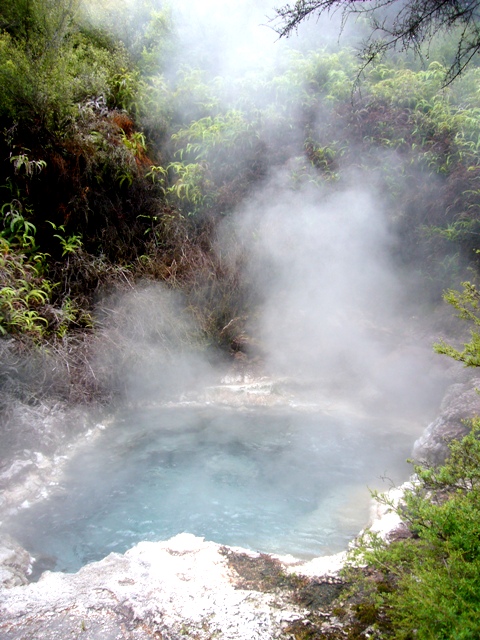
We then headed to Orakei Korako. In Maori, Orakei Korako means “adorned place” and the name refers to the colourful mineral deposits that have come out of the hot springs and geysers. According to the literature, 20 million litres (about 5 million gallons) of water flows up out of the springs every day and into Lake Ohakuri which was formed when a hydroelectric dam was built on the Waikato River. You take a boat ride across the lake and explore the pools and streams.


It’s hard to tell from this picture, but that pool is boiling and bubbling away.
And this is a bubbling mud pool.

We headed back to Auckland after stopping at Maungatautari. I realised that I hadn’t been stuck in traffic or had to stop at a red light since we’d left!

We returned home rejuvenated with lots of good ideas and energized by the positive community networking we had a chance to experience. It’s great to see that even communities with different interests can live and work together for the common good.
Happy holidays and all the best in 2015!


 testazyk.com